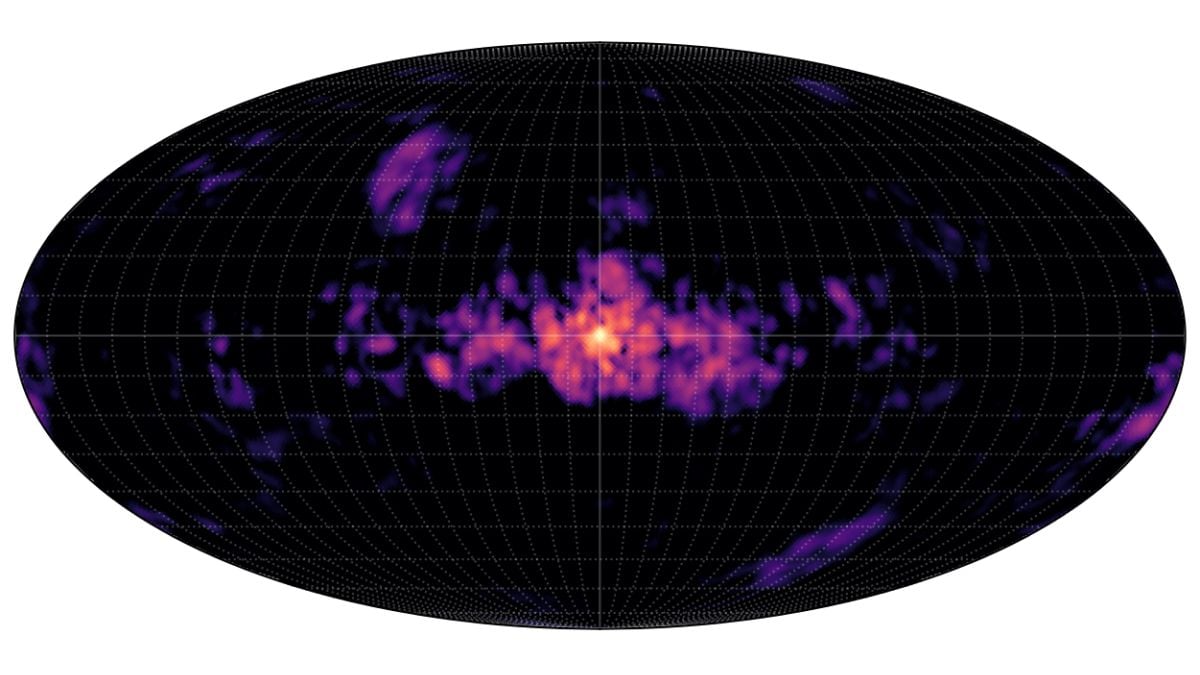
Astronomers say they may have spotted antimatter signals coming from beyond the Milky Way for the first time. If confirmed, the finding would mark a major step in understanding where some of the Universe’s positrons originate and could reshape a long-running debate about unexplained antimatter activity tied to our own galaxy.
For years, researchers have tried to explain why the center of the Milky Way appears to host so many positrons, the antimatter counterparts of electrons. When positrons meet electrons, the particles destroy each other and release a distinctive signal. That long-observed pattern has been difficult to fully account for, making the galactic center one of astronomy’s enduring puzzles.
The new report suggests at least some of these antimatter signatures may not be limited to sources inside the Milky Way. Instead, scientists think they may be seeing evidence of positron-related activity from much farther away, beyond our home galaxy. Because the result is described cautiously, it remains a candidate detection rather than a settled conclusion.
Even so, the possibility of a first extragalactic antimatter signal is significant. It offers a new avenue for studying how antimatter is produced in space and whether the Milky Way’s strange central signal is part of a broader cosmic phenomenon rather than an isolated local mystery.