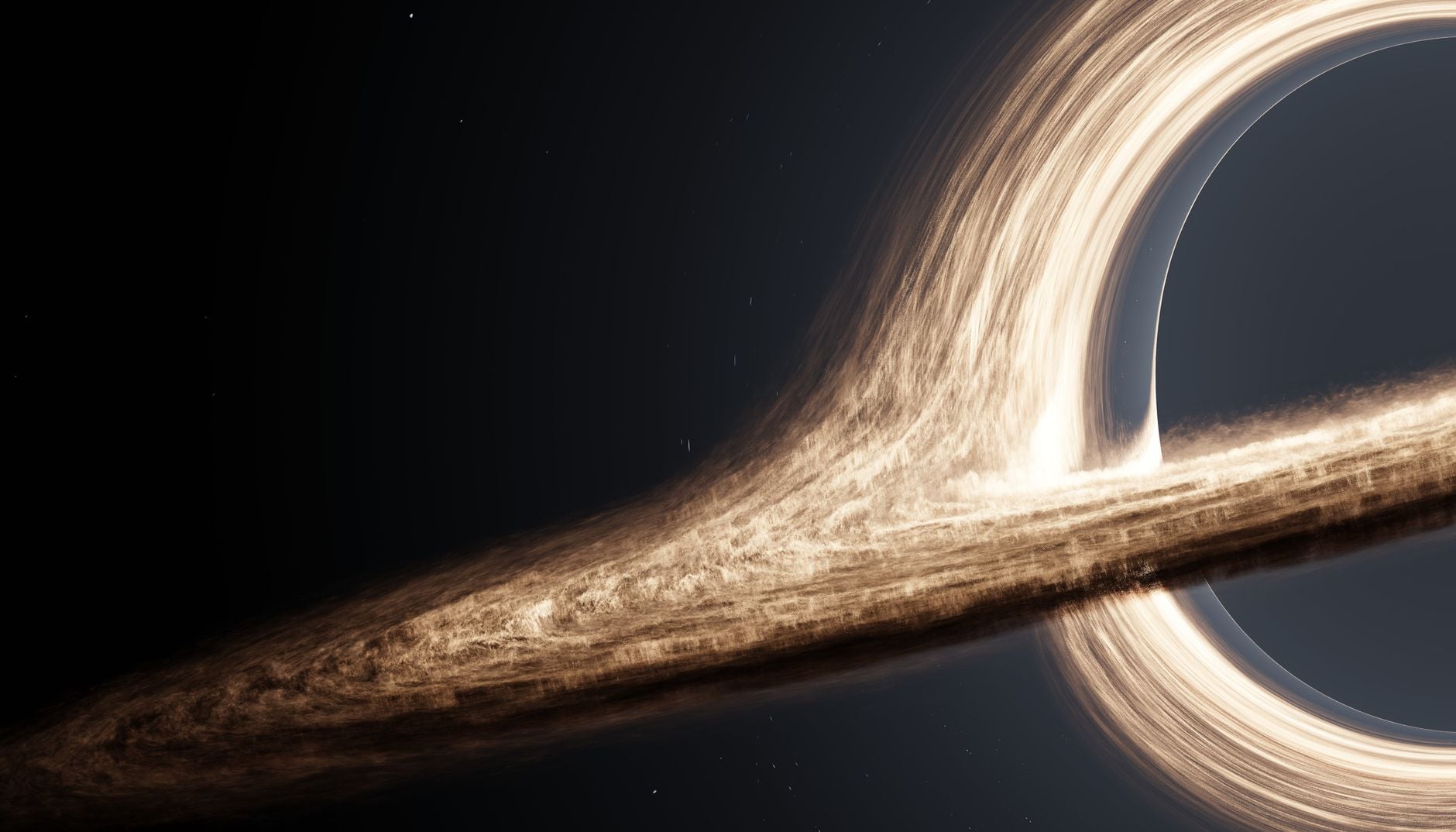
A young blue star near the centre of the Milky Way has become one of astronomy’s clearest clues to the presence of a supermassive black hole. About 26,000 light-years from Earth, the star swings around an invisible object with a mass roughly four million times that of the Sun, reaching nearly 3 per cent of the speed of light at its fastest point.
What makes the object so striking is that it gives off no light of its own, yet its gravity dominates the region around it. By watching the star’s repeated close approach and sharp turn, astronomers were able to map an orbit that would be impossible without an extremely compact and massive body at the galaxy’s core.
Those observations were not made quickly. Researchers tracked the star’s motion for nearly three decades, building a long record of how it accelerates and curves through space. That long-term monitoring provided strong evidence for what physics had predicted: the Milky Way’s centre is anchored by a supermassive black hole.
The work became a landmark result in modern astronomy, showing how precise measurements of a single star can reveal the nature of an otherwise hidden cosmic object. It also helped bring top recognition to the astronomers behind the decades-long effort, turning a strange stellar orbit into one of the strongest demonstrations of a black hole at the heart of our galaxy.