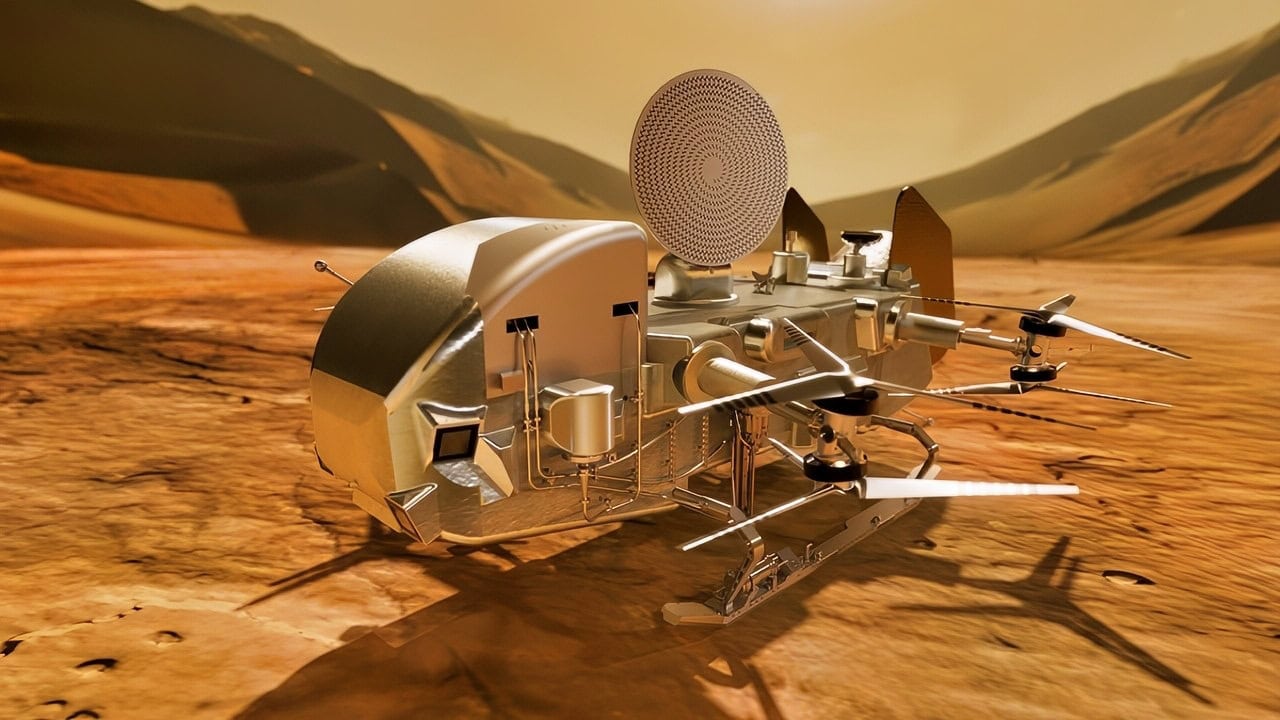
NASA is preparing to send Dragonfly, a car-sized, roughly 1,000-pound nuclear-powered rotorcraft, to Saturn’s moon Titan in July 2028. The mission is described as a six-year journey with a total cost of about $3.35 billion, making it one of the agency’s most unusual planetary exploration projects.
What sets Dragonfly apart is its design. Rather than crawling slowly across the surface like Mars rovers such as Curiosity or Perseverance, this spacecraft is built to fly from one location to another. Its eight-rotor configuration is intended to let it make repeated hops across Titan, reaching multiple sites that would be difficult for a traditional rover to explore.
Titan offers conditions that make aerial travel especially practical. The moon’s atmosphere is about four times denser than Earth’s, while gravity is only about one-seventh as strong. That combination means generating lift is far easier there than on our planet, giving Dragonfly a major advantage as it moves around the alien landscape.
The Dragonfly mission stands out because it blends nuclear power, rotorcraft flight and long-range planetary science in a way NASA has not attempted before. If the current plan holds, the mission will open a new chapter in robotic exploration by testing whether flying vehicles can become a powerful tool for studying distant worlds.