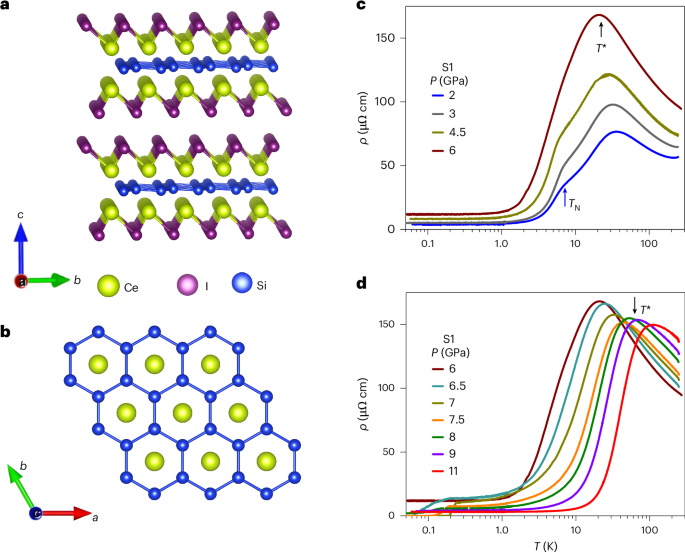
Researchers reporting in Nature have identified superconductivity under pressure in CeSiI, a two-dimensional van der Waals heavy-fermion metal. The work focuses on how this layered material changes as pressure is applied, offering a closer look at the conditions that allow superconductivity to emerge.
According to the study description, the key result is the observed interplay between antiferromagnetism, Kondo coherence and unconventional superconductivity. That combination matters because heavy-fermion systems are known for strong electronic correlations, and CeSiI appears to provide a compact platform where several competing quantum states can be followed in the same material.
The van der Waals nature of CeSiI also makes the finding notable. Layered materials are often discussed for their tunability and for the possibility of exploring new electronic phases in reduced dimensions. In this case, pressure serves as the control knob, letting researchers probe how magnetic order and correlated-electron behavior evolve toward a superconducting state.
The study adds CeSiI to the growing list of materials used to investigate unconventional superconductivity in strongly interacting systems. By connecting pressure, magnetism and Kondo physics in a two-dimensional heavy-fermion metal, the research opens another route for studying quantum matter in layered compounds.





