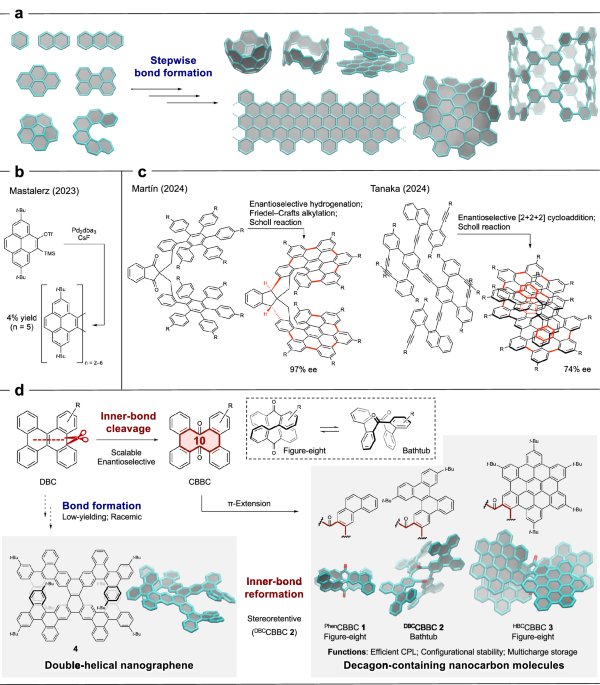
Researchers reporting in Nature describe a skeletal transformation strategy for making chiral nanocarbon molecules, a class of three-dimensional carbon structures that are important for advanced materials research. The work focuses on a different route to these molecules than the methods commonly used today.
According to the study description, existing synthetic approaches largely depend on stepwise bond-forming reactions. That can limit how efficiently complex nanocarbon architectures are assembled, especially when the target molecules have three-dimensional shapes and chirality. The newly reported method instead uses a skeletal transformation approach, pointing to a way of reshaping a molecular framework rather than building it only bond by bond.
Chiral nanocarbon molecules are seen as valuable building blocks because their structure can influence the behavior of larger carbon-based materials. A practical method for producing these molecules could expand the toolbox for chemists working on nanoscale carbon systems and related functional materials.
While the available excerpt mainly covers materials and experimental setup, the headline and summary indicate that the central advance is methodological. If broadly applicable, the skeletal transformation concept could help researchers access three-dimensional chiral nanocarbons that are difficult to obtain through conventional multistep synthesis.