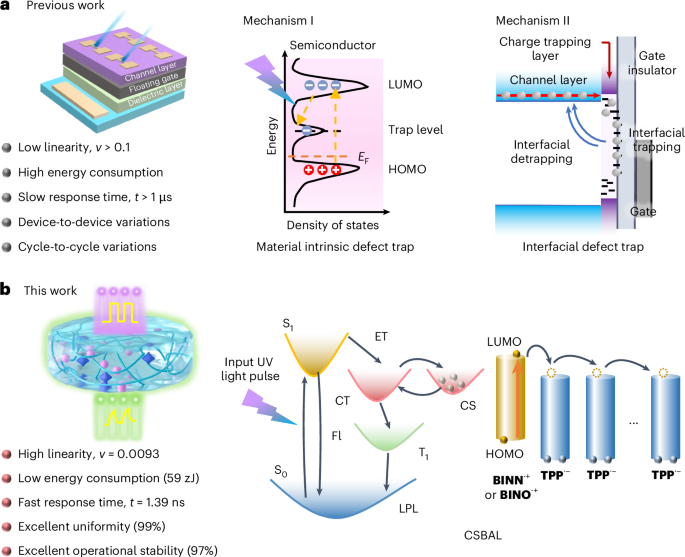
A new Nature study examines organic synapses with programmable linearity for neuromorphic computing, a field that aims to build hardware that works more like the brain. The research focuses on a major challenge for organic artificial synapses: interfacial effects and nonlinear electronic processes can make device behavior harder to control and less suitable for high-performance computing tasks.
According to the description, the team developed a highly efficient organic all-photonic synapse. The key advance is the achievement of linear synaptic responses, which are important because predictable, gradual changes in signal strength are useful for learning and memory functions in neuromorphic systems.
The reported linearity is linked to optically tailored charge separation. In practical terms, that suggests the researchers used light-based control to tune how charges are generated and managed inside the device, helping reduce the unwanted nonlinear behavior that often limits organic synapse performance.
The work points to a possible route for improving organic neuromorphic hardware by combining the advantages of organic materials with more programmable and reliable synaptic operation. If such approaches continue to improve, they could support future low-power, brain-inspired computing technologies that rely on efficient artificial synapses.