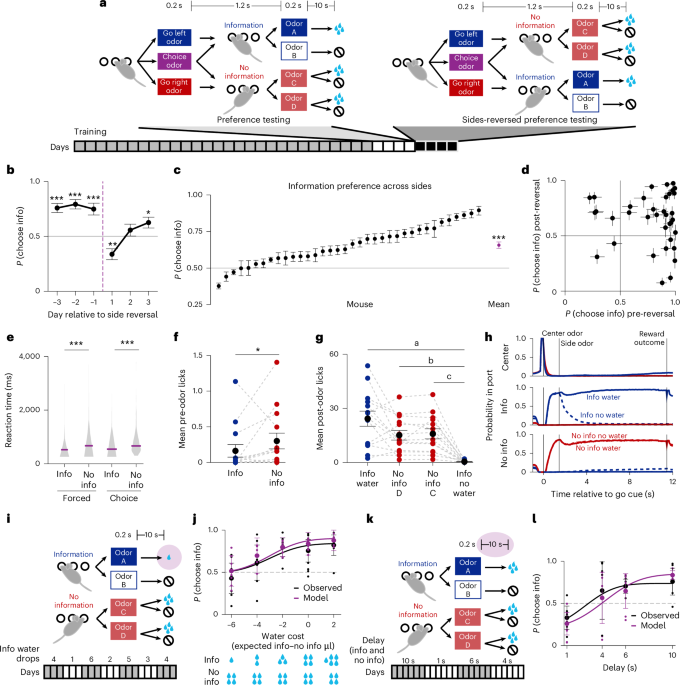
A new Nature study examines why mice will work to obtain information even when that information offers no direct physical reward. The research focuses on the orbitofrontal cortex, a brain region often linked to evaluating outcomes and guiding choice.
According to the study summary, the key finding is that neural activity in the mouse orbitofrontal cortex reflects the value of information itself. That signal appears to be separate from the brain’s representation of physiological reward, suggesting that the drive to know something can be tracked independently from the drive to get food or another tangible benefit.
This matters because it gives a clearer picture of how information-seeking behavior is organized in the brain. Rather than treating curiosity-like behavior as a simple byproduct of reward pursuit, the findings point to a distinct internal valuation process for information, even when it has no obvious external payoff.
The work adds to broader neuroscience research on decision-making, learning and motivation. By showing that mice assign intrinsic value to information and that this value is represented in orbitofrontal cortex activity, the study offers a new framework for understanding how brains weigh knowledge against more basic rewards.