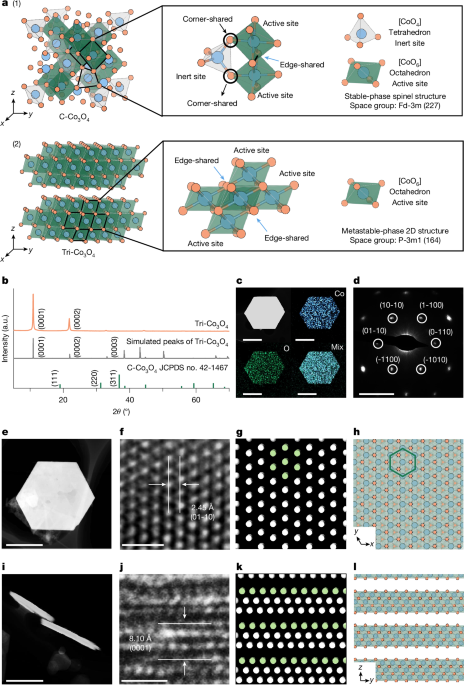
A Nature study describes a new trigonal-phase form of cobalt oxide, Co3O4, designed for acidic water electrolysis. The material was produced with a vacuum-mediated molten-alkali mechanochemical method, giving researchers a different crystal arrangement from the more familiar spinel-type Co3O4.
The key structural feature highlighted in the report is edge-shared octahedral coordination. That octahedral framework sets the trigonal phase apart from conventional cobalt oxide structures and helps explain why the material is being examined as an oxygen evolution catalyst under acidic conditions.
According to the summary, the trigonal Co3O4 achieved a lower overpotential than spinel-type Co3O4 in the acidic oxygen evolution reaction. Lower overpotential is an important benchmark in water electrolysis because it points to more efficient catalytic performance during the oxygen-producing half of the process.
The work suggests that tuning cobalt oxide through phase and coordination changes could open a new route for acid-stable electrolysis research. Rather than relying only on standard spinel cobalt oxides, the study shows that a trigonal, octahedrally coordinated Co3O4 can offer a meaningful performance advantage in acidic operation.