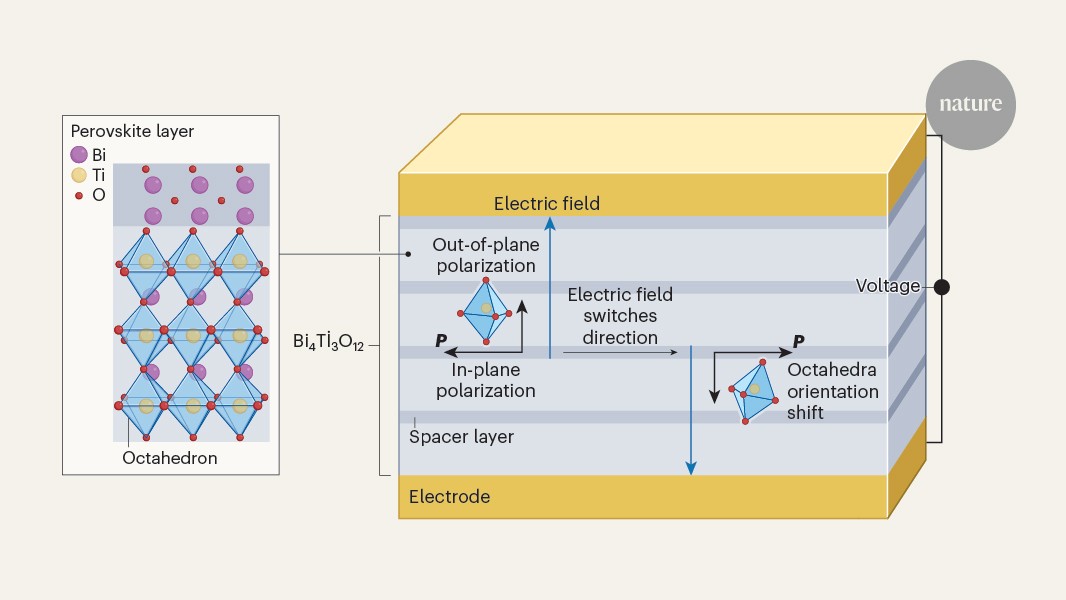
Researchers reporting in Nature describe a thin ferroelectric film in which electric dipoles do not behave only in the usual out-of-plane direction. Instead, the work points to a lateral, or sideways, component that is linked to the vertical polarization of the material.
That coupling between horizontal and vertical polarization is important because it suggests an unconventional way to control a ferroelectric film without needing an unusual device design. In practical terms, the study indicates that standard device geometry could still be used to manipulate this more complex polarization behavior.
Ferroelectric materials are widely studied because their electric polarization can be switched, making them useful for memory and other electronic applications. A thin film that combines in-plane and out-of-plane responses could expand how engineers think about switching, readout and integration in future components.
Although the trimmed report offers limited technical detail, the main result is clear: the film shows an unexpected polarization arrangement, and that arrangement can still be addressed in a familiar device setup. That makes the finding notable both for basic ferroelectric physics and for the design of next-generation thin-film electronics.