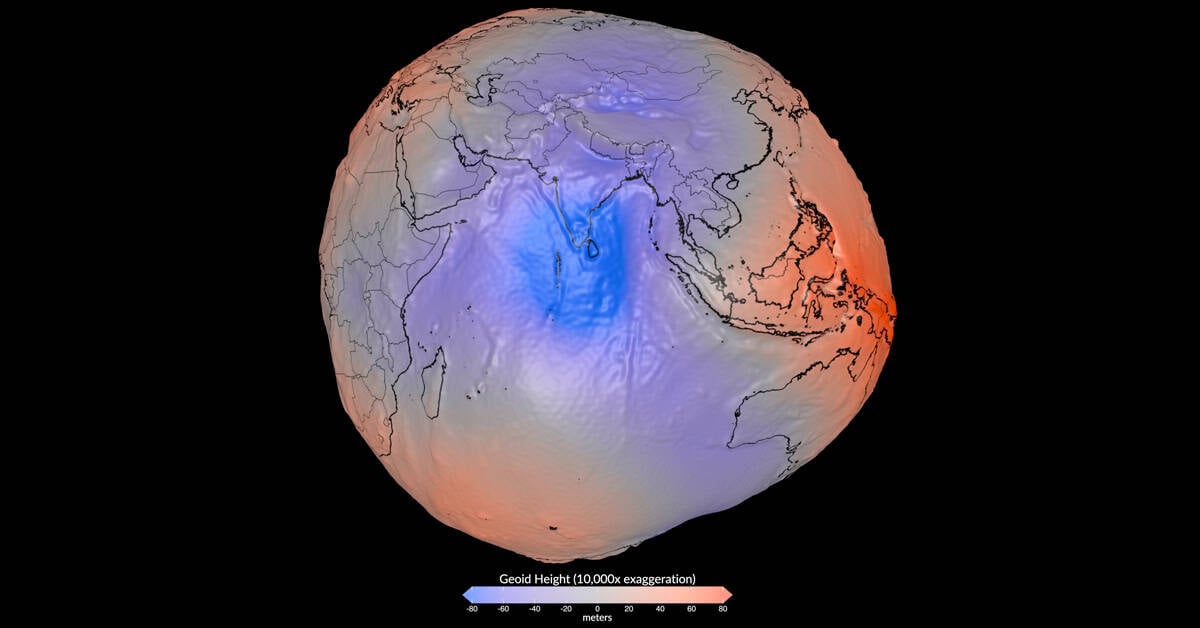
NASA has unveiled a high-precision model showing that Earth is not represented best as a perfect sphere when gravity is taken into account. Built from satellite data, the model presents a lumpy, uneven version of the planet that has been compared to a potato, offering a striking alternative to the familiar smooth blue globe.
The finding does not mean Earth’s surface literally looks like a potato from space. Instead, the model highlights how gravity differs from place to place across the planet. Those subtle changes create an irregular shape in the gravity field, revealing a more complex picture of Earth than the simple round image many people learn first.
According to the description of the model, NASA used detailed measurements gathered by satellites to map these variations with high precision. That approach helps scientists visualize how mass is distributed around the planet and how gravity behaves on a global scale.
The result is a reminder that Earth’s true form depends on what is being measured. Visually, the planet may appear close to spherical, but a gravity-based model tells a more complicated story—one shaped by uneven forces across the world.