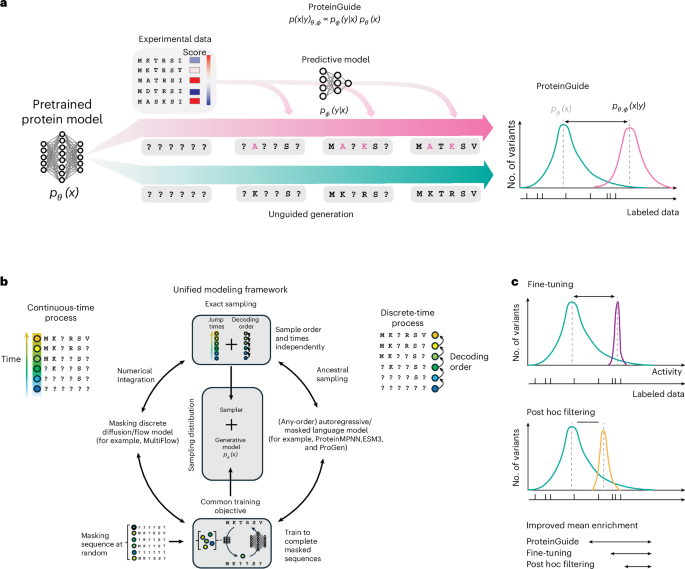
A Nature report highlights ProteinGuide, a method designed to give protein sequence generative models more direct control over the kinds of proteins they create. The core idea is on-the-fly conditioning, which means a pretrained model can be guided during generation so that proposed sequences better match targeted properties.
This matters because protein design has moved quickly with deep-learning systems that can generate or optimize sequences, but practical use often depends on steering those systems toward clear goals. A guidance layer such as ProteinGuide suggests a way to keep the speed and flexibility of pretrained generative models while improving how well they align with desired functional or structural characteristics.
The article sits within a broader wave of computational protein engineering that includes tools for deep-learning-based sequence design. The reference list in the trimmed snippet points to earlier work such as ProteinMPNN, showing that ProteinGuide is being discussed in the context of rapidly advancing methods for designing proteins with machine learning.
In simple terms, the advance described by Nature is about making protein generation more controllable rather than purely open-ended. If that approach proves effective across different design tasks, it could help researchers use generative protein models more reliably when they need sequences tuned for specific properties.