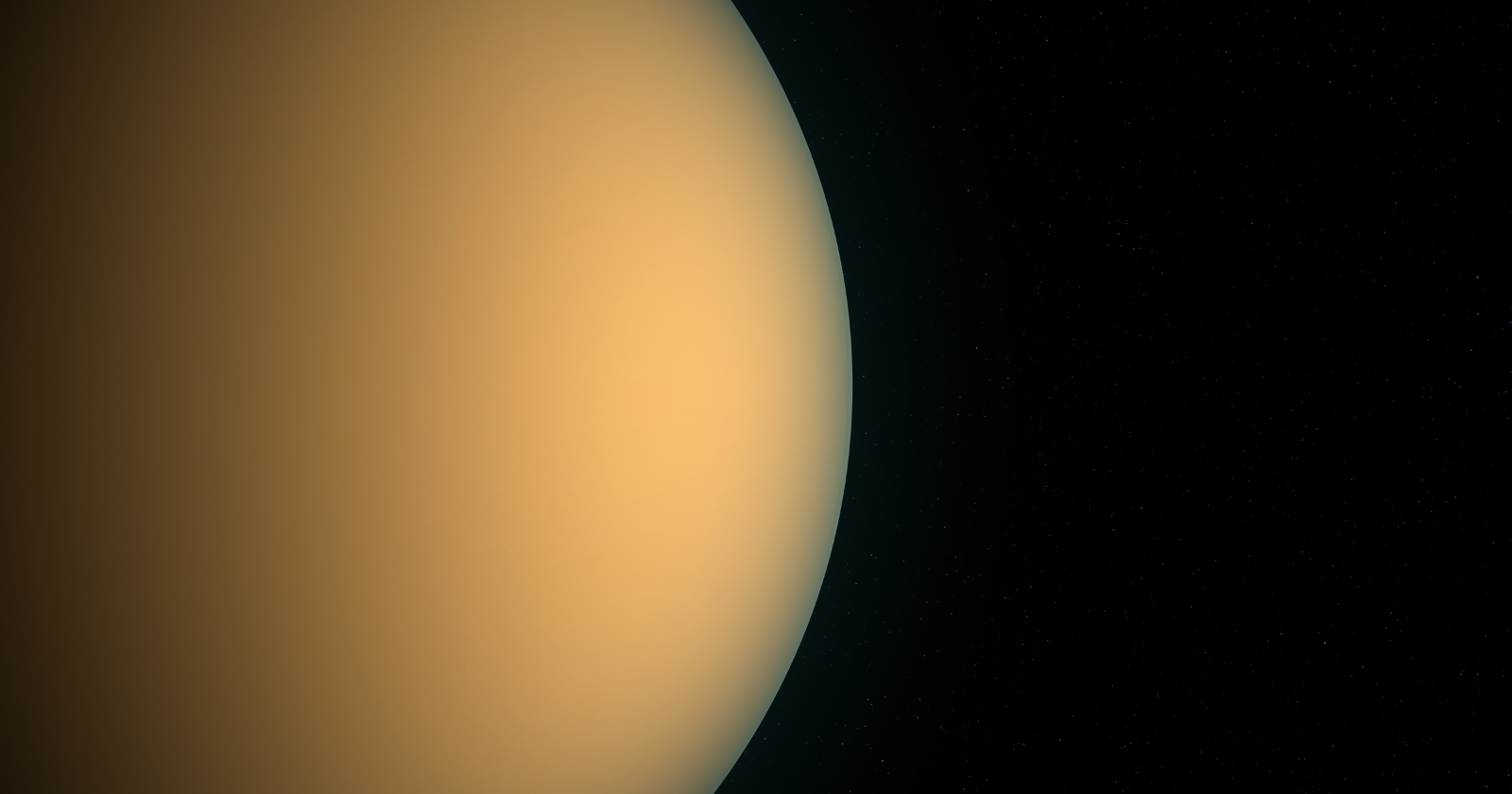
Titan, Saturn’s largest moon, rotates so slowly that one full spin takes almost 16 Earth days. Because it is locked to Saturn, Titan keeps the same face turned toward the planet at all times, creating a striking split between the moon’s two hemispheres.
On the side facing Saturn, the ringed planet would hang in the sky almost permanently instead of rising and setting in the way Earth’s Moon does for us. From the opposite side of Titan, Saturn would never be visible at all. It is not hidden by weather or horizon timing; it simply never comes into view from that half of the moon.
This pattern is the result of tidal locking, a common outcome in planetary systems. Titan’s slow rotation and its constant orientation toward Saturn mean the same geography always points inward, while the far side always points away. That creates a world where the view of the sky depends completely on which hemisphere you stand on.
The result is a dramatic example of how orbital mechanics shape alien landscapes. On Titan, Saturn is either a permanent presence dominating the sky or a planet that does not appear at all, depending entirely on location.