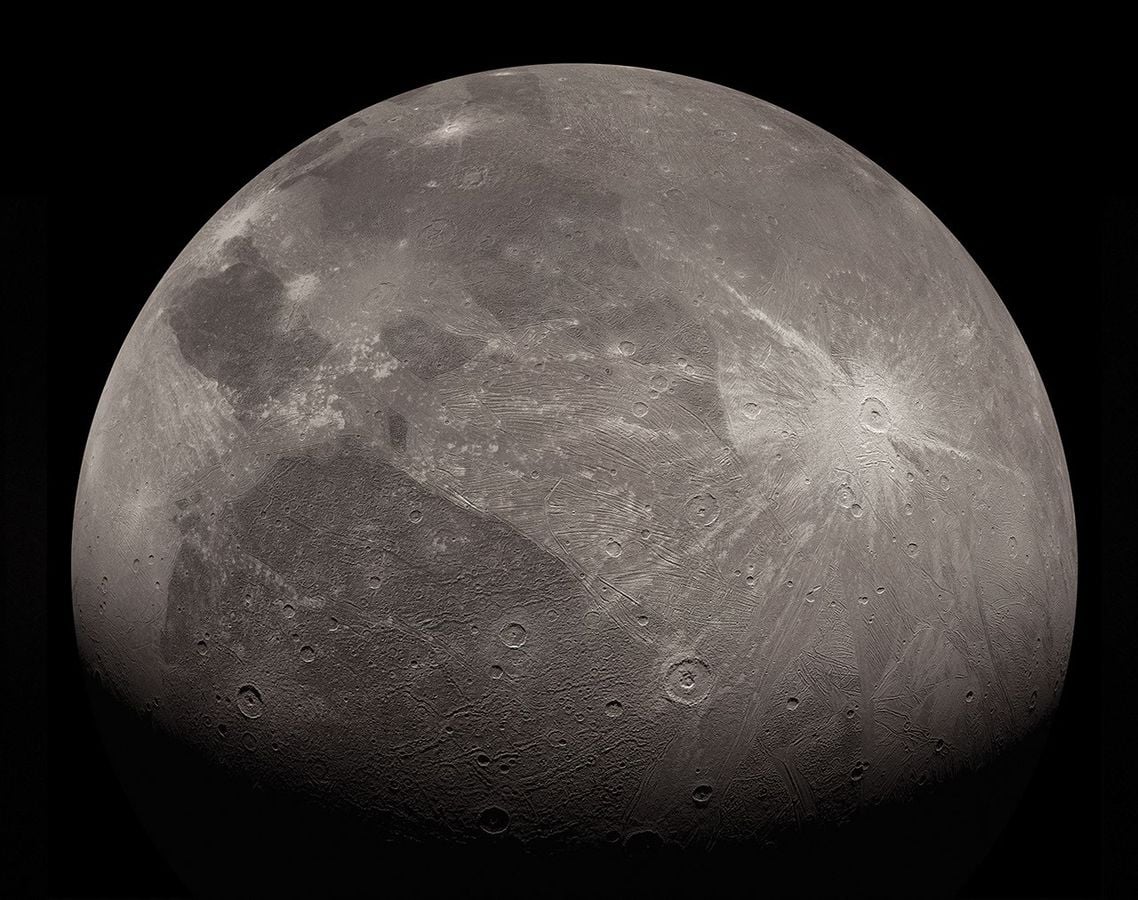
Ganymede is officially classified as a moon, but its scale and structure make that label feel too small. Orbiting Jupiter, it is the largest moon in the Solar System, measuring about 5,262 kilometres across. That makes it bigger than the planet Mercury, placing it in a category that feels closer to a world in its own right than a typical satellite.
What makes Ganymede stand out even more is the possibility that it holds enormous amounts of water, potentially more than the water found on Earth’s surface. Combined with its geologically complex nature, that has made it a major focus for planetary scientists trying to understand how such a large and layered object formed and evolved around Jupiter.
Another unusual feature is that Ganymede generates its own magnetic field. That is rare for a moon and adds to the view that it behaves less like a conventional companion to a planet and more like a miniature planetary system. Its internal activity and structure appear to be far more sophisticated than the word moon usually suggests.
Researchers continue to see Ganymede as one of the Solar System’s most intriguing objects because it blurs the line between moon and planet. Its size, suspected water content and magnetic environment help explain why scientists view it not simply as Jupiter’s largest moon, but as a full-scale world that happens to orbit another one.





