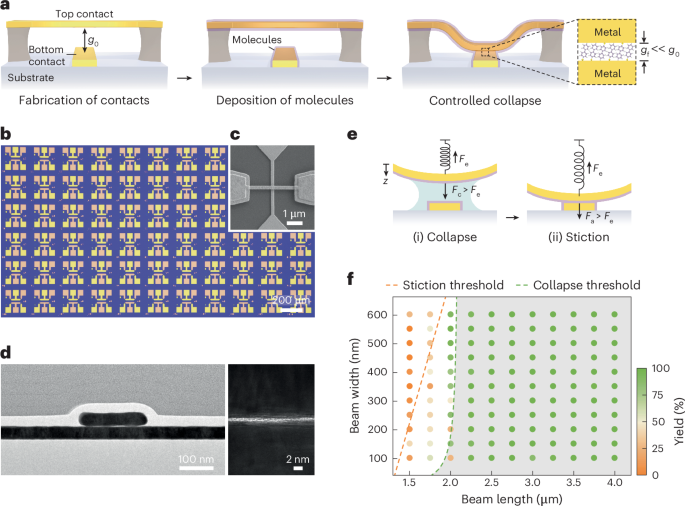
Researchers reporting in Nature describe a self-assembled contact strategy aimed at improving how molecular materials are connected inside electronic devices. The work focuses on a long-standing challenge in molecular electronics: creating reliable electrical contacts without harming delicate molecular layers during fabrication.
According to the description, the method uses a soft contact approach that supports high-yield molecular devices while avoiding damage to the active material. That is important because molecular components can be difficult to integrate with standard device architectures when conventional contact methods are too harsh or inconsistent.
A key point of the report is scalability. The approach is presented as being compatible with conventional semiconductor manufacturing processes, suggesting it could fit more easily into existing production workflows rather than requiring entirely new fabrication systems. For molecular electronics, that combination of yield, gentler processing and manufacturing compatibility is a notable step.
The broader significance is that self-assembled contacts for molecular electronic devices may help move the field closer to practical applications. By improving contact formation and preserving molecular materials, the technique could support more reproducible device performance and wider testing of molecular components in future electronics.