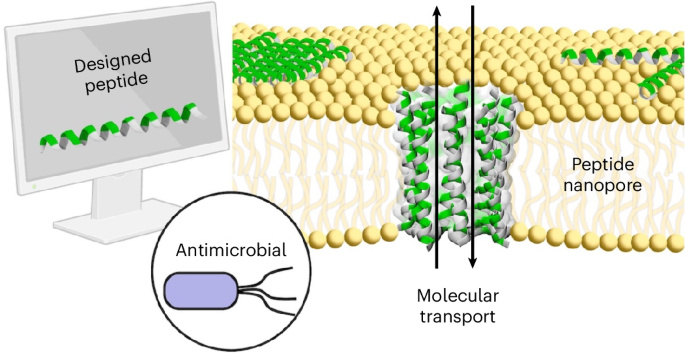
Researchers reporting in Nature describe a computational approach for antimicrobial peptide nanopore design, focusing on α-helical molecules that can assemble into transmembrane barrel-stave pores, or TBPs. The work centers on de novo design, meaning the peptides are created through a design framework rather than simply selected from naturally occurring sequences.
According to the study summary, the team built a strategy to pinpoint residue-level features that help stabilize these membrane-spanning pores. The snippet indicates that roughly 150 systematically varied amphipathic 30-residue α-helical peptides were used in the design effort, giving the researchers a way to compare how sequence changes affect pore formation and stability.
The main application highlighted is antimicrobial activity. By designing peptides that can organize into controlled nanopores in membranes, the research points to a possible route for creating new antimicrobial agents with structures tailored for function rather than found by trial and error alone.
Beyond antimicrobial use, the paper also suggests broader possibilities for these designed peptide nanopores. The same barrel-stave pore architecture could be relevant for nanopore sensing and drug-related delivery technologies, showing how computationally designed membrane pores may extend into multiple areas of biotechnology and molecular engineering.