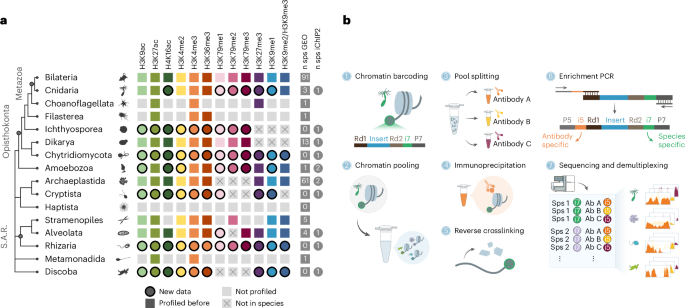
A Nature study reports a new method called iChIP2, designed as a low-input chromatin immunoprecipitation followed by sequencing approach. The technique is presented as a way to profile histone post-translational modifications, or hPTMs, at the same time across a wide range of eukaryotic species.
The research focuses on chromatin regulatory states, which help control how genes are used in cells. Although many histone modifications are conserved across eukaryotes, the study highlights that the broader regulatory states built from those marks can still differ substantially between organisms.
By applying iChIP2 across diverse species, the authors examine both the diversity and the evolution of chromatin organization. The work points to a more detailed picture of how shared molecular marks are deployed in different combinations, producing distinct regulatory patterns across the eukaryotic tree.
Overall, the study positions iChIP2 as a useful tool for comparative epigenomics, especially when sample input is limited. Its main contribution is to make cross-species analysis of chromatin states more practical, while also offering new insight into how gene regulation has evolved in eukaryotes.