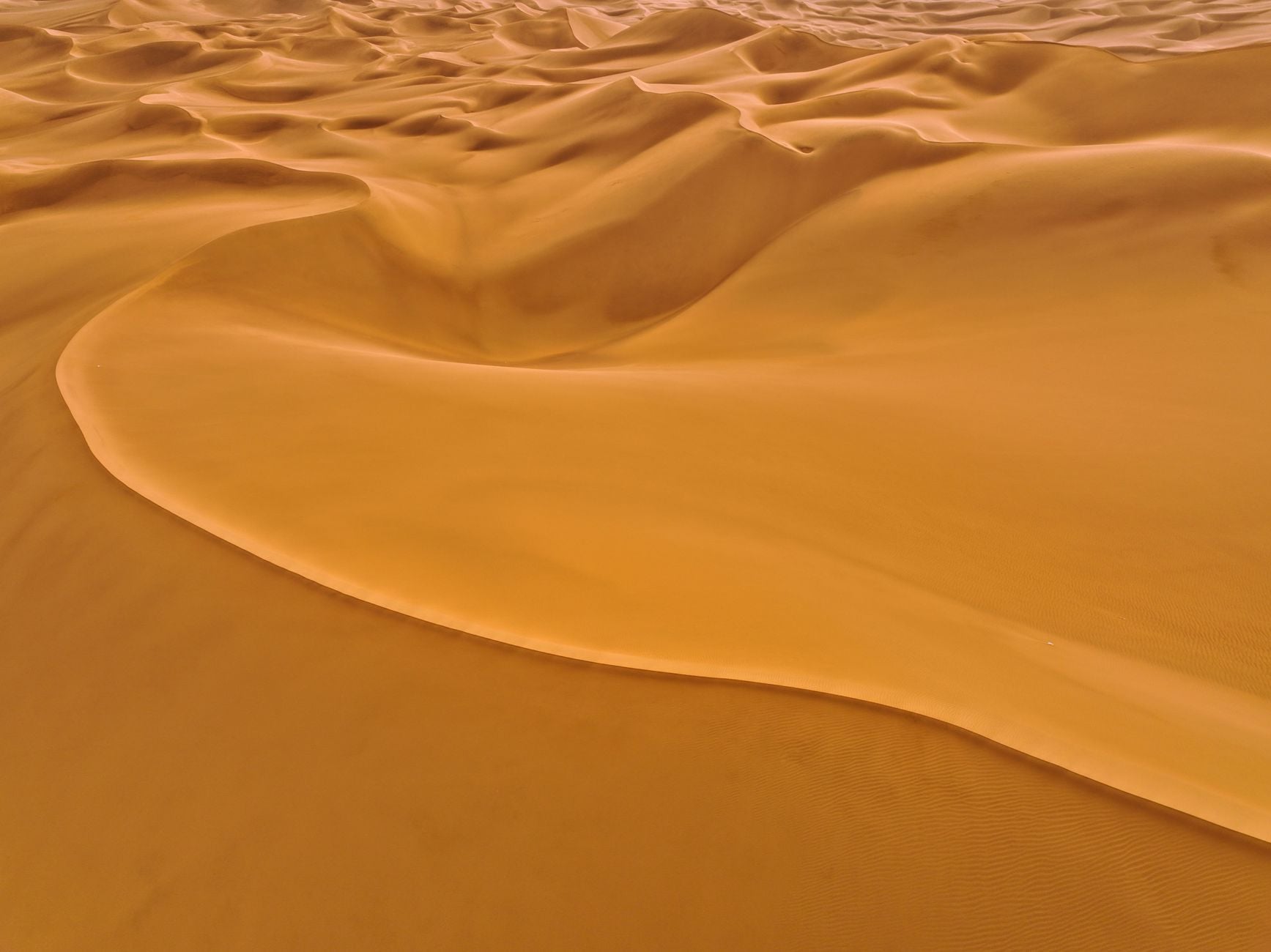
Vast dune fields stretch across Titan’s equator, forming one of the most striking landscapes seen on Saturn’s largest moon. Radar observations from NASA’s Cassini mission revealed dark, largely parallel belts of dunes running through the equatorial regions, showing that wind has played a major role in shaping Titan’s surface.
The ridges are enormous by earthly standards. Individual dunes are commonly about one to two kilometres wide, roughly 100 metres high, and can extend for tens to hundreds of kilometres. Their scale and alignment suggest persistent wind patterns over long periods of time, steadily building and organizing the dunes into broad belts.
What makes Titan’s dunes especially unusual is the material they appear to be made from. Rather than sand like that found in deserts on Earth, the grains are described as water ice coated in hydrocarbons. Those hydrocarbon compounds are thought to have fallen out of Titan’s thick orange atmosphere before being reworked at the surface by the moon’s winds.
Together, the findings highlight Titan as a world where familiar-looking landforms arise from very different ingredients. Cassini’s radar mapping showed that even in the cold outer Solar System, atmospheric chemistry and surface winds can combine to create sweeping dune landscapes on a planetary scale.





