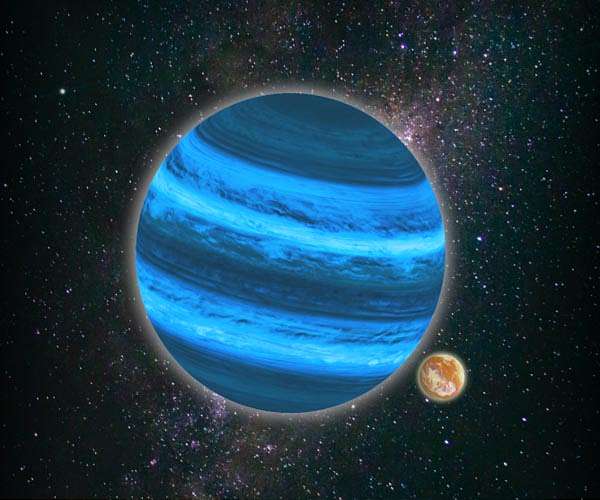
New research points to a surprising possibility in the search for life: a world may not need a parent star to stay habitable. According to a 2026 modelling study from Ludwig Maximilian University of Munich, an Earth-sized moon circling a Jupiter-like rogue planet could maintain liquid water on its surface for up to 4.3 billion years.
That timespan is comparable to much of Earth’s own history, making the finding notable for astrobiology. Rogue planets, which drift through space without orbiting a star, are usually seen as cold and hostile. But the study suggests that under the right conditions, a moon in orbit around one of these planets could remain warm enough to support oceans even in deep darkness.
The result broadens the usual definition of where life-friendly environments might exist. Instead of focusing only on planets in a star’s habitable zone, scientists may also need to consider moon-and-planet systems far from any sunlight. In this scenario, the key factor is not starlight but the specific pairing of a large rogue planet and a suitable moon.
If the modelling holds up, starless planetary systems could become an important target in future efforts to understand where life might arise beyond Earth. The study adds to growing evidence that potentially habitable environments may exist in places once thought too extreme to matter.





