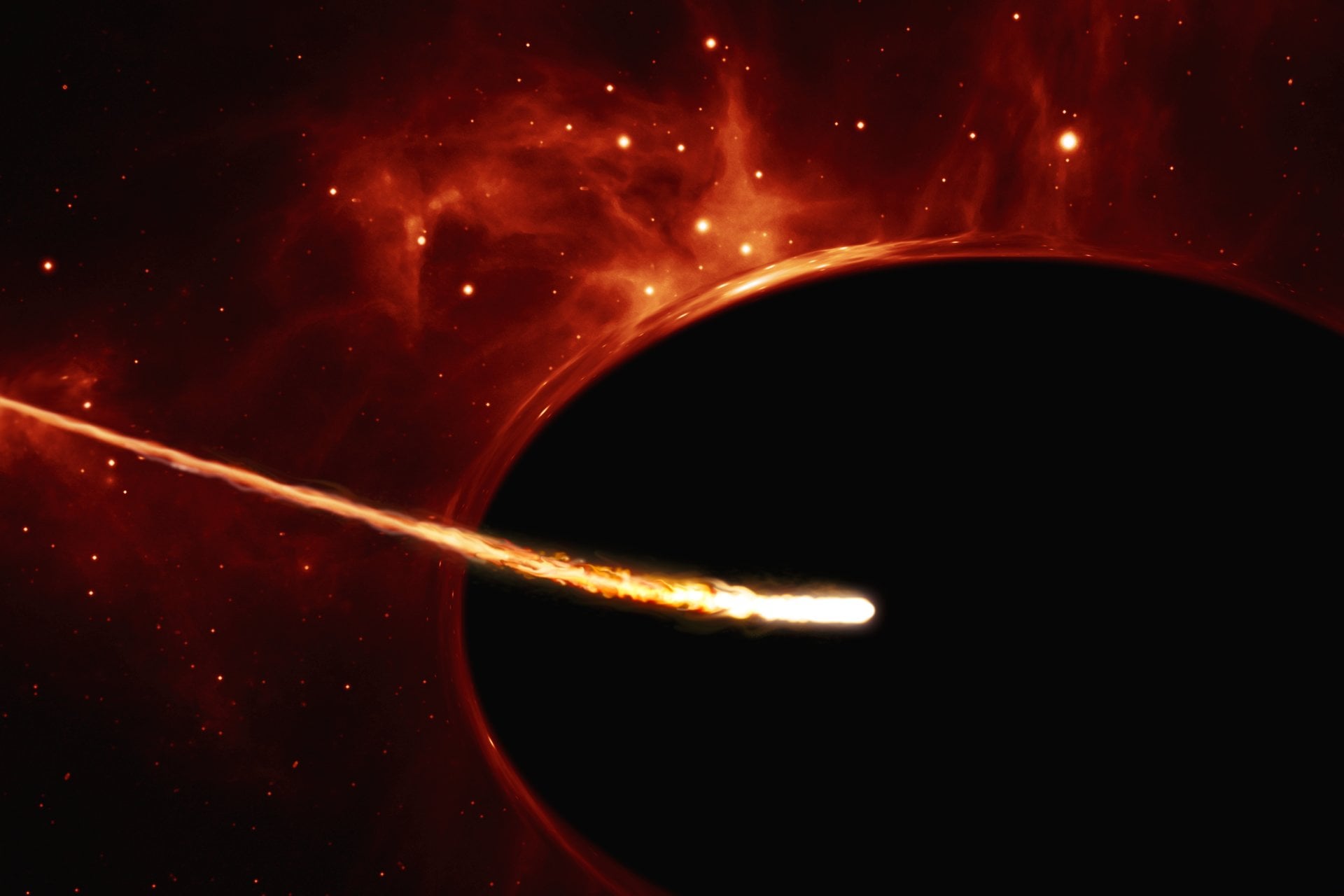
A Sun-like star circling the supermassive black hole at the center of the Milky Way is helping astronomers push gravity theories to their limits. The star travels so close to the black hole that its distance is comparable to Neptune’s orbit around the Sun, and at its fastest it moves at more than 8% of the speed of light.
Those extreme conditions make the system especially important for testing general relativity. In many everyday situations across the universe, Newton’s description of gravity is accurate enough to explain how objects move. But near a supermassive black hole, gravity is so intense and speeds are so high that Einstein’s theory becomes essential.
By tracking the star’s path, researchers can look for subtle effects that would not appear in a simple Newtonian model. Its orbit offers a rare natural laboratory where the predictions of relativity can be examined in a real astrophysical setting rather than only in weaker gravitational environments.
Because stars like this are difficult to observe and only a few are known to pass so near the Milky Way’s central black hole, each measurement carries added value. The star’s motion gives astronomers a clearer view of how gravity behaves under some of the most extreme conditions found in our galaxy.