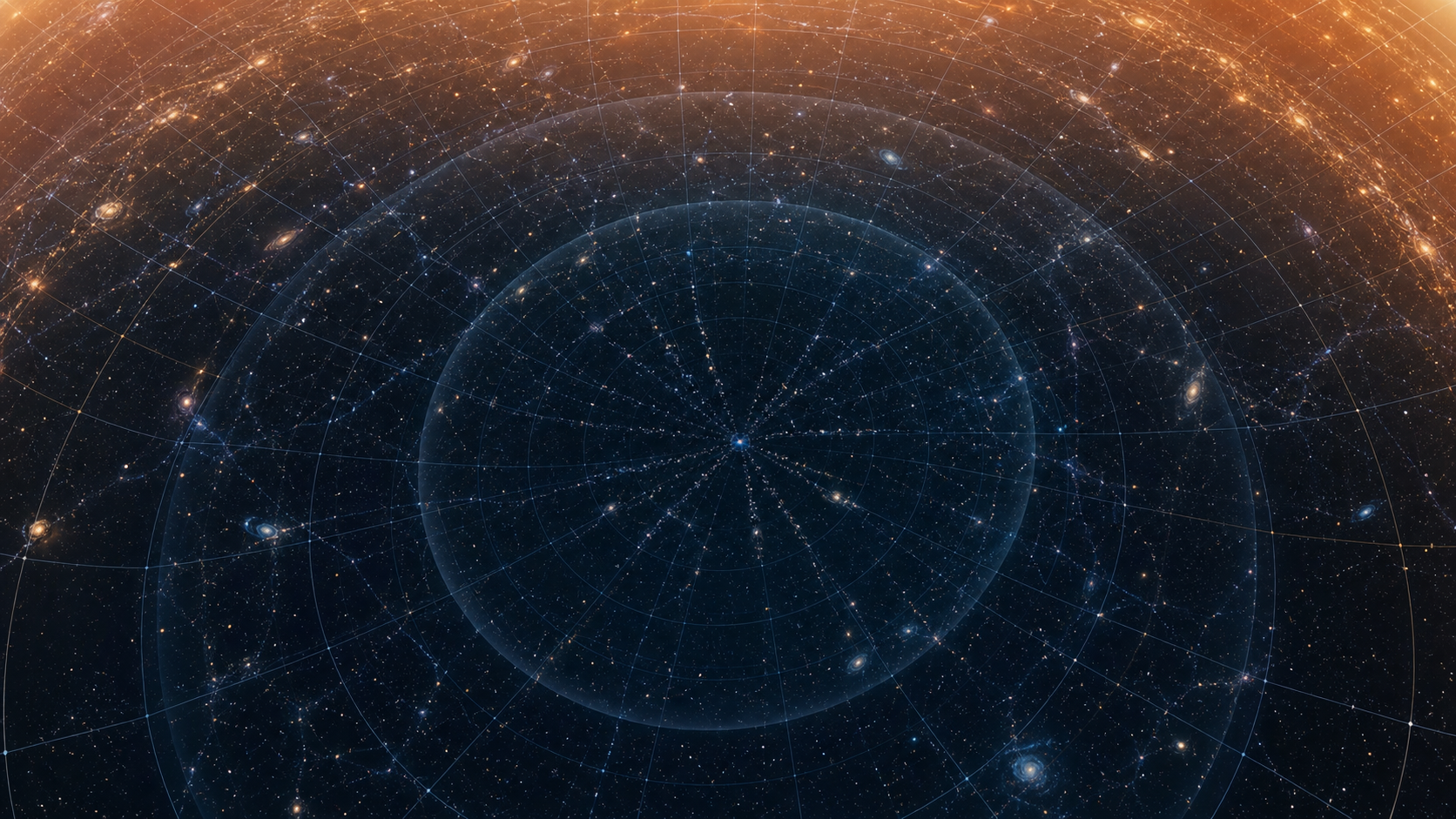
The observable universe is often described as roughly 93 billion light-years across, even though the universe itself is about 13.8 billion years old. At first glance, that can seem impossible if light has only had 13.8 billion years to travel. The key point is that this calculation does not happen in a static universe.
The apparent contradiction comes from imagining space as a fixed room, where distance stays the same while light moves from one side to the other. Modern cosmology describes something very different: space itself has been expanding while that light was on its way. As a result, the regions that emitted the oldest light we can now detect are much farther away today than they were when the journey began.
That means the age of the universe does not directly set the present-day diameter of the observable universe at 13.8 billion light-years, or even twice that amount. Instead, the expansion of space stretches the gap over time, allowing the current observable span to be far larger. The oldest visible light has traveled for billions of years through a universe that did not remain the same size.
In short, the vast scale of the observable cosmos is not evidence of a mistake in the age estimate. It reflects the difference between how long light has been traveling and how much the universe has expanded during that trip. That is why a 13.8-billion-year-old universe can still have an observable width of about 93 billion light-years.





