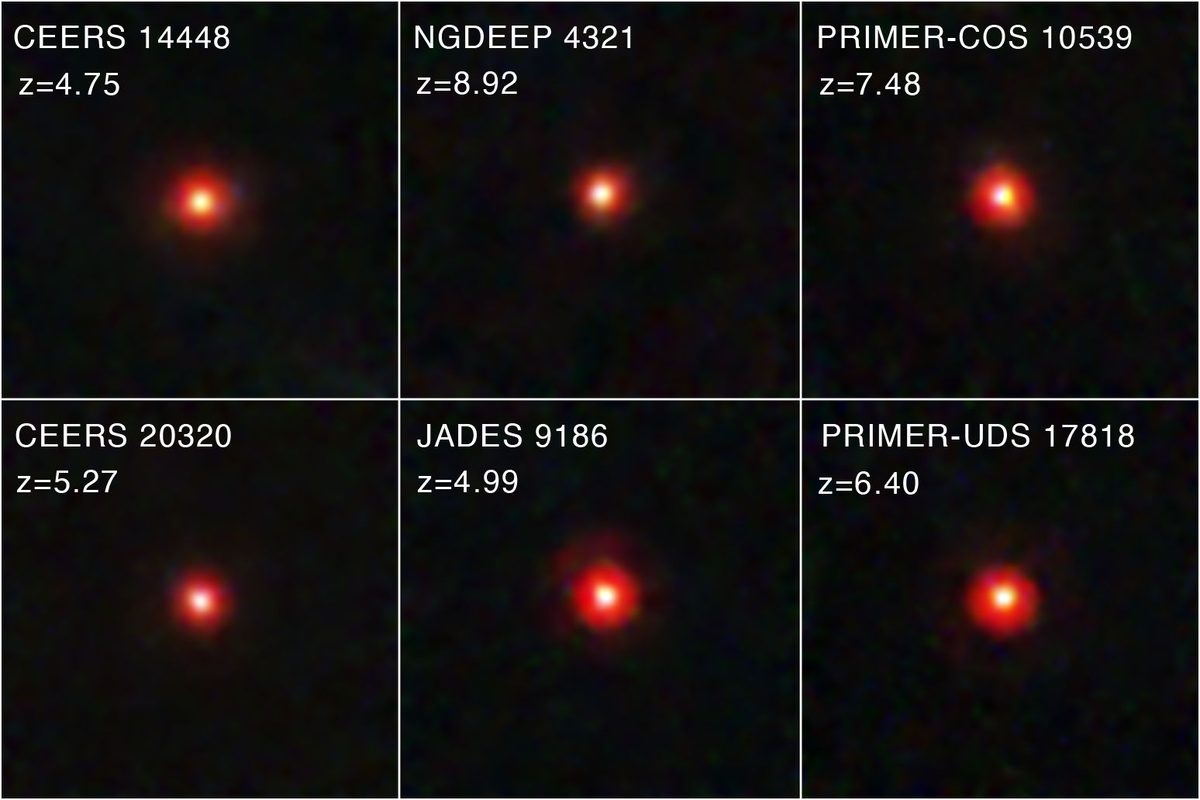
Astronomers are working to explain the mysterious “little red dots” spotted by the James Webb Space Telescope in the early Universe. These compact, reddish objects were not expected before Webb began observing deep space, and their appearance has sparked wide debate about what they really are.
A new idea suggests that at least some of these objects could be relatively light black holes hidden inside thick envelopes of dense gas. In this model, the gas around the black hole changes how the object looks, producing features that line up with much of what astronomers have observed in these unusual red sources.
The theory is drawing attention because it may help bridge a gap between what scientists expected to find and what Webb actually detected. Rather than being easy to classify as ordinary young galaxies or clearly active black holes, the little red dots appear to sit in a puzzling middle ground, which is why they have become such an active topic in astronomy.
While the proposal is intriguing, the nature of the little red dots is still not settled. Researchers will need more observations and further modeling to determine whether dense gas around small black holes is the best explanation, or whether these early-Universe objects represent something even more complex.