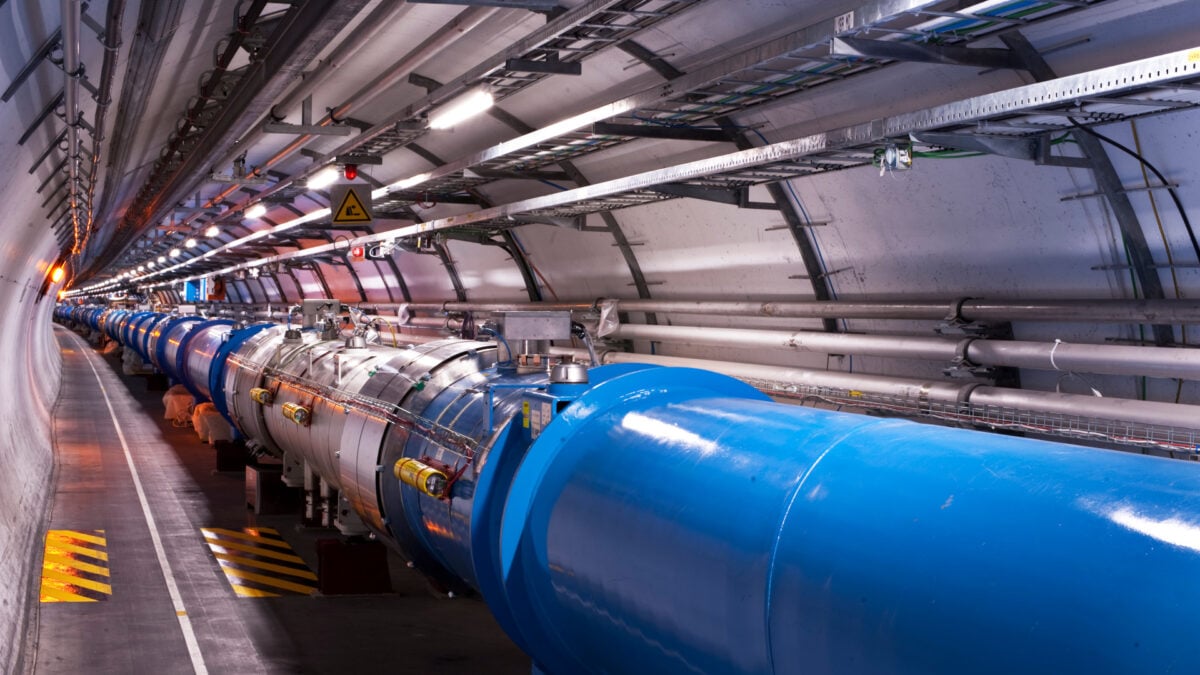
The Large Hadron Collider, the massive particle accelerator operated by CERN beneath the French-Swiss border, has gone quiet as it enters its most ambitious upgrade so far. After years of colliding protons at extreme speeds, the machine is being prepared for a new stage of research that scientists hope will deliver far more detailed data about the building blocks of the universe.
This upgrade matters because the collider has already played a central role in modern physics, helping researchers probe matter at the smallest scales. With improved capabilities, the next run is expected to push those studies further, giving physicists more chances to examine rare particle interactions and test long-standing ideas about how nature works.
What makes this moment especially important is the possibility that the upgraded collider could expose gaps in current theory. If future experiments reveal unexpected patterns or results, they could challenge established models and point researchers toward new physics beyond what is currently understood.
For now, the silence underground marks a transition rather than a slowdown. The Large Hadron Collider is being readied for a more powerful chapter, one that could deepen knowledge of fundamental forces and potentially reshape the direction of particle physics.