Researchers reporting in Nature say they have found evidence for a planetary-mass exosatellite orbiting CD-35 2722 B, a brown dwarf that is itself a companion to a star. The object is being described as an exomoon-like candidate because it appears to circle a substellar companion rather than a full-sized star.
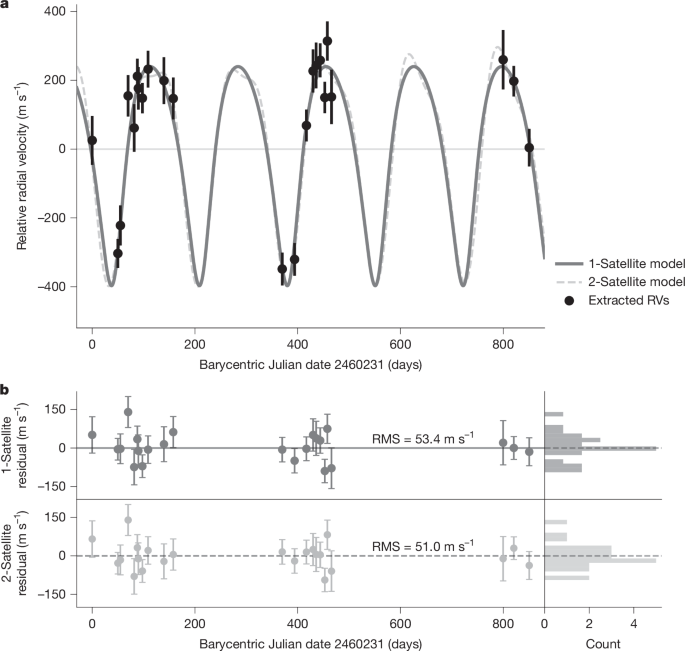
The finding is based on radial velocity measurements, a method that tracks subtle shifts in motion to infer the presence of an unseen companion. In this case, the data point to a body with a mass comparable to Jupiter, suggesting a very large satellite around the brown dwarf.
If confirmed, the result would stand out because moons beyond the Solar System have been far harder to identify than exoplanets. A detection in such an unusual setting would also widen the range of environments where astronomers can look for complex orbital systems, including satellites around brown dwarfs and other substellar objects.
The report adds to ongoing efforts to move exomoon research from tentative hints to stronger observational evidence. While follow-up work will be important, the study highlights CD-35 2722 B as a promising system in the search for moon-like worlds beyond our planetary neighborhood.