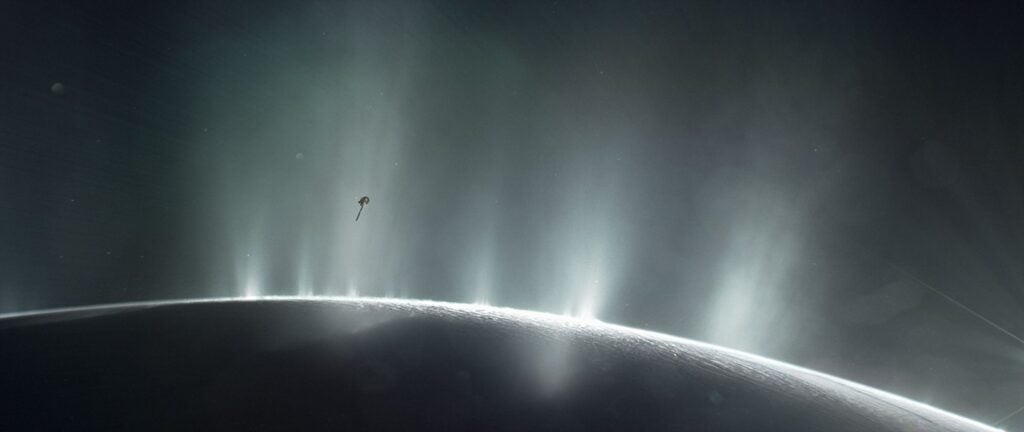
The search for life beyond Earth is usually framed around a breakthrough discovery: a microbe, a biomarker or a chemical signal that strongly points to living activity. But the idea highlighted in new discussion around Enceladus is that a negative result could also be scientifically transformative. If researchers find no evidence of life in its ocean, that outcome may still answer one of astrobiology’s biggest questions.
Enceladus is considered one of the most promising places to look because it appears to offer many of the ingredients associated with habitability. The world is thought to have liquid water, internal heat, phosphorus and complex organic chemistry. In simple terms, it seems to check many of the boxes that scientists often view as favorable for life.
That is why an absence of detectable biology would matter so much. If a place with those conditions still shows no clear sign of living processes, it could mean that habitability is more demanding than researchers currently assume. The missing factor might be a crucial environmental condition, a rare chemical pathway or a step in the origin of life that is far less common than hoped.
In that sense, Enceladus could help science whether life is found or not. A positive detection would be historic, but a careful non-detection could be nearly as important because it would narrow the field of possibilities and force a rethink of how life begins in the universe. For astrobiology, learning that the right ingredients do not automatically lead to biology would be a major result in its own right.





