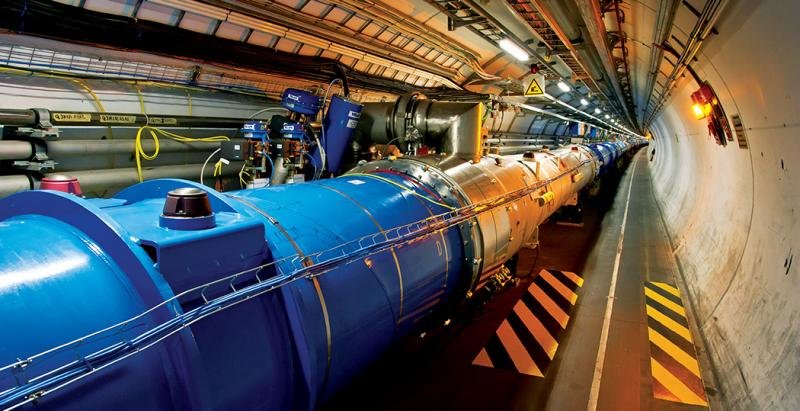
Scientists working at the Large Hadron Collider have reported new evidence that collisions involving oxygen and neon may produce an extreme state of matter similar to the one believed to have filled the universe just after the Big Bang. The update is notable because it comes from all four of the collider’s main experiments, pointing to a broad and consistent signal across the facility.
Researchers have long used heavy-ion collisions to study how matter behaves under extraordinary temperatures and densities. The latest results suggest that even smaller collision systems, such as oxygen and neon, may be able to recreate some of the same early-universe conditions that physicists are trying to understand.
The finding adds to a growing effort to map out when and how this unusual state of matter appears. By comparing different kinds of atomic collisions, scientists can test which ingredients are needed for this behavior to emerge and how it changes from one system to another.
Because the signs were seen by all four major LHC experiments, the results are likely to draw close attention in particle physics. They could help refine current models of matter under extreme conditions and offer a new way to study the first moments of cosmic history through experiments on Earth.