A new analysis argues that Ukraine’s drone effort is no longer just about small battlefield strikes, but about pressuring Russian supply networks far behind the front. The central question is whether large numbers of coordinated drones could do more than harass troops and instead help create conditions for meaningful territorial gains.
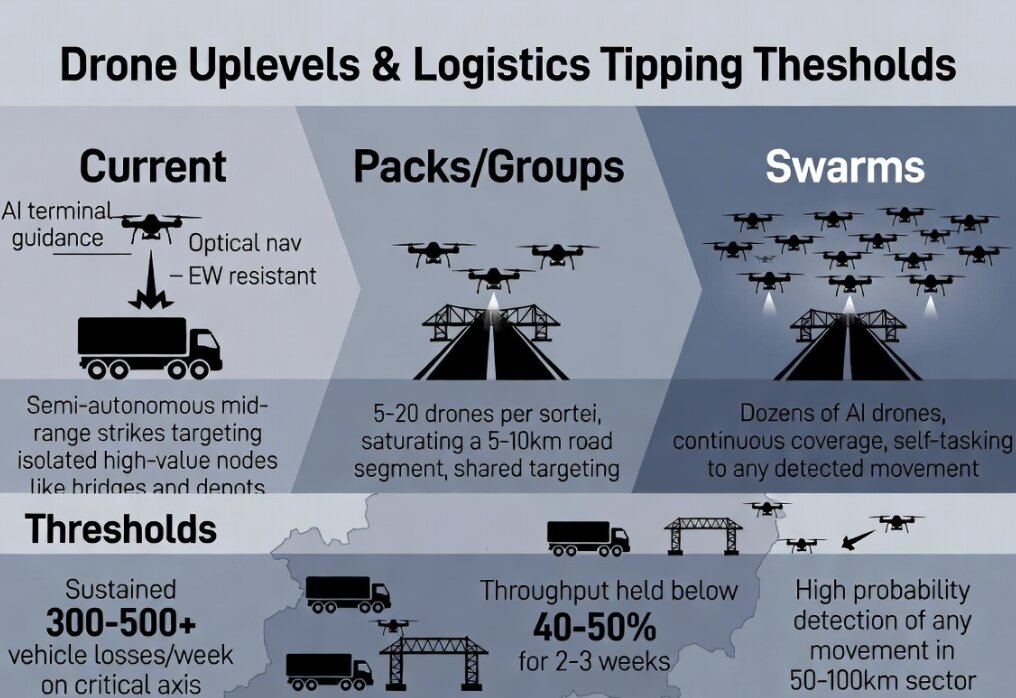
The focus is on the southern route linking occupied areas to Crimea, along with nearby approaches in Zaporizhzhia and Kherson. If drones can repeatedly hit transport, storage, and movement along that corridor, the effect could be larger than individual attacks suggest. Sustained disruption at that depth could slow reinforcements, complicate resupply, and weaken Russia’s ability to hold ground efficiently.
That idea points to a broader shift in modern warfare. Drone swarms, if used at scale and with enough persistence, may offer a cheaper way to strain an opponent’s logistics than relying only on traditional artillery or aircraft. In that sense, the technology would not simply add another weapon to the battlefield, but potentially reshape how armies defend rear areas and maintain front-line operations.
Still, the article presents this as a developing scenario rather than a settled outcome. Whether drone swarms can translate logistical pressure into major land gains would depend on continued effectiveness, available production, and how quickly Russian forces adapt. Even so, the analysis suggests that Ukraine’s drone campaign could become one of the most important factors in changing the character of the war.