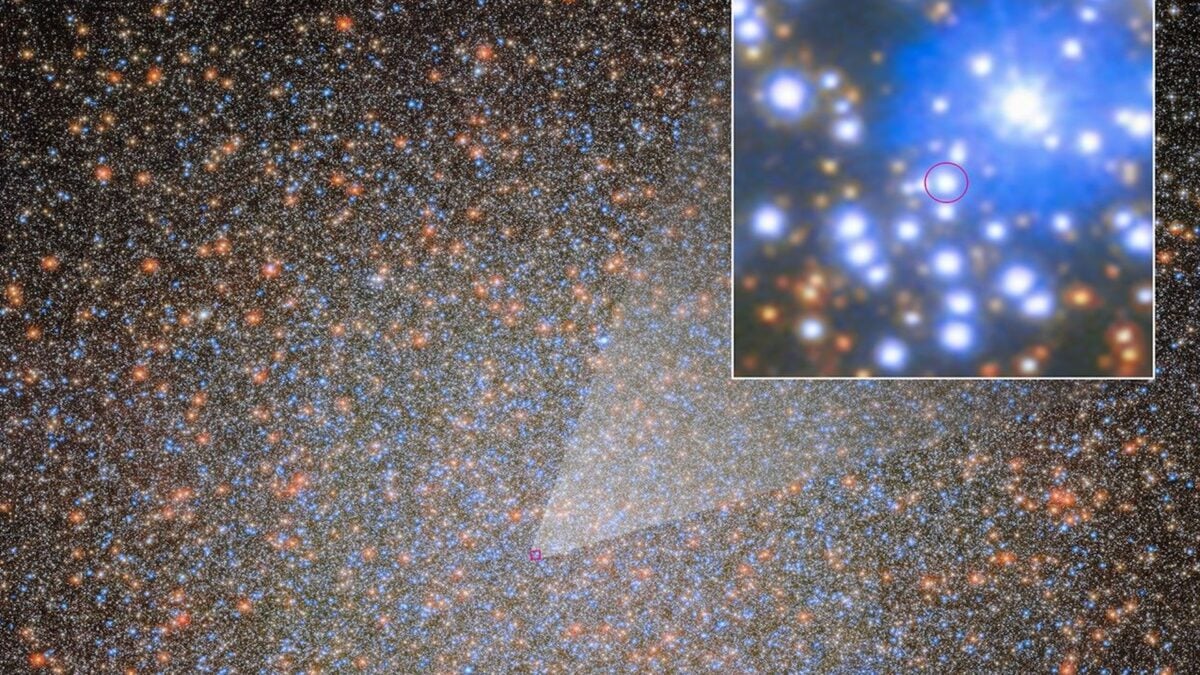
Astronomers have identified a long-sought black hole inside Omega Centauri, a massive star cluster that researchers believe could be home to many more. The find stands out because scientists have suspected for years that this cluster may contain around 10,000 small black holes, yet none had been directly spotted until now.
The discovery came from following the motion of a single star over roughly two decades. By mapping its orbit, researchers found that the star was circling an unseen but heavy object. Their analysis points to that hidden companion being a stellar-mass black hole.
The result adds important evidence to the idea that dense star clusters can conceal large numbers of black holes that are difficult to detect. Because black holes do not emit light, astronomers often have to infer their presence from how nearby stars move, especially when the objects are buried inside crowded regions packed with stars.
If the new finding holds up, it could strengthen the case that Omega Centauri contains a vast population of these compact objects. That would make the cluster an especially important target for future studies aimed at understanding how black holes form, survive, and remain hidden inside some of the busiest stellar environments in space.