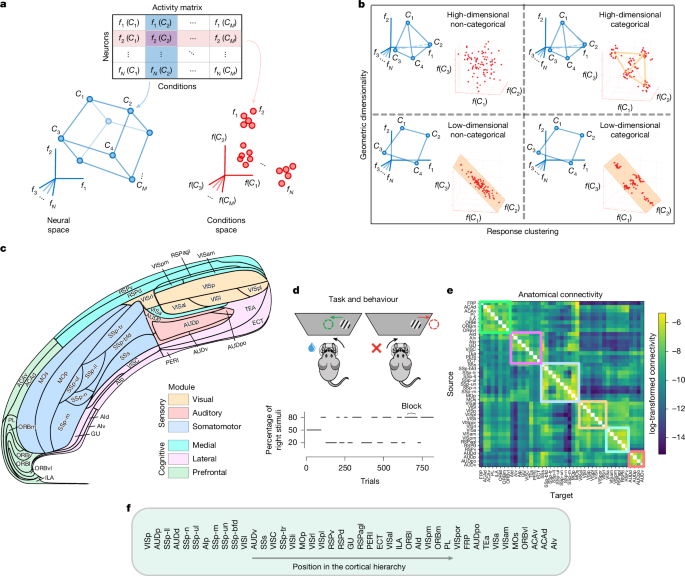
Research published in Nature points to a different view of how the cortex organizes information. Rather than relying mainly on tidy, category-like groupings, the study suggests cortical activity is more often diverse and spread across high-dimensional patterns that remain strongly separable.
The work examines representations along the cortical hierarchy, a broad term for the progression of processing across brain regions. Based on the paper’s description, the central finding is that cortical circuits appear to prioritize diversity over rigid categorical structure, creating a computational setting that can keep different kinds of information distinct without forcing them into simple bins.
To investigate this, the researchers used public data from the International Brain Laboratory, drawing on time-series information tied to task performance, behavior and electrophysiological recordings from experimental sessions. That combination allowed them to compare neural activity with what subjects were doing and how signals were structured across the cortex.
The overall takeaway is that the cortex may support flexible computation by maintaining rich, highly separable representations instead of depending heavily on categorical coding. If that interpretation holds broadly, it could shape how scientists think about perception, decision-making and the way large neural populations encode complex information.