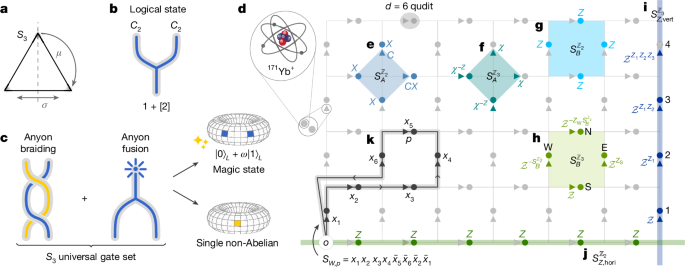
Researchers reporting in Nature describe a 54-qubit experiment that realizes non-Abelian S3 topological order on quantum hardware, a result tied to one of quantum computing’s most ambitious goals: fault-tolerant computation built from anyons. The work highlights how exotic quasiparticles and topological phases can be engineered and studied on programmable devices rather than only in theory.
The central advance is the combination of two anyon operations, braiding and fusion, to produce universal quantum gates. Braiding refers to exchanging anyons in ways that encode information through topology, while fusion probes how those anyons combine. According to the study description, using both together moves the platform beyond a more limited set of protected operations and toward universal topological quantum computation.
That matters because topological approaches are widely seen as a promising route to more robust quantum processing. In this framework, information is stored in global properties of the system, which can offer protection against certain local errors. The Nature result builds on long-running theoretical ideas around anyons, fault tolerance and topological order, and gives a concrete hardware-based demonstration of concepts that have often been discussed in abstract terms.
While the report does not by itself mean large-scale topological quantum computers are imminent, it marks a notable step for quantum hardware and for the study of non-Abelian phases. Demonstrating S3 topological order on a 54-qubit device and showing that braiding plus fusion can support universal gates suggests a clearer experimental path for turning topological quantum computation from theory into practice.