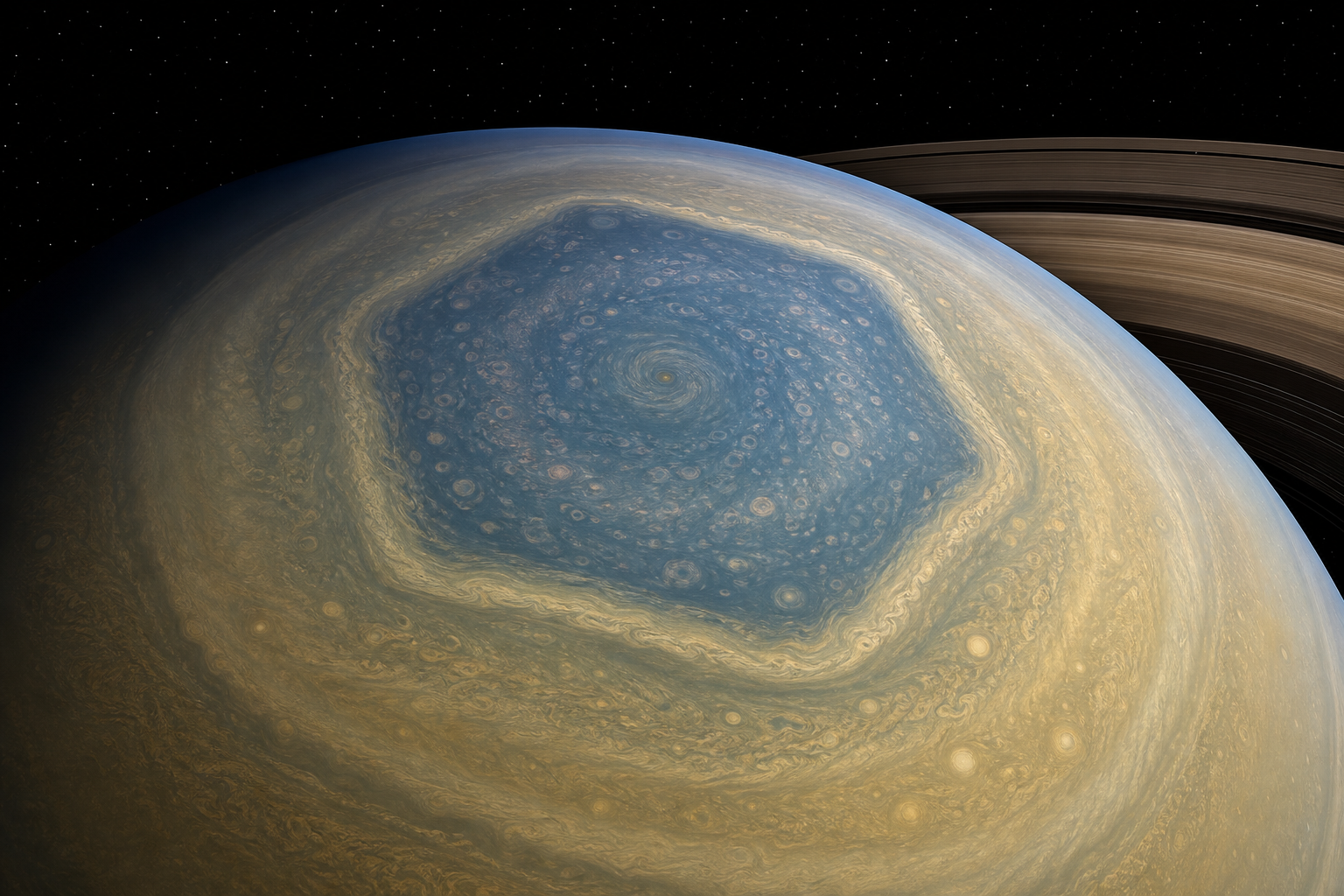
One of the most unusual weather patterns in the solar system sits above Saturn’s north pole: a massive six-sided storm system that stretches about 30,000 kilometers across, making it wider than Earth. Scientists have studied the feature for years, yet they still do not have a complete explanation for why its striking geometric form remains intact.
The storm is defined by fast-moving clouds that trace six broad edges and six corners, creating a shape that looks far more precise than most atmospheric systems. That regular outline stands out on a gas giant known for powerful winds and dynamic cloud bands, turning the polar region into a persistent scientific mystery.
Researchers think Saturn’s jet streams, winds and large-scale atmospheric waves may play important roles in shaping the hexagon. Even so, the bigger question is not only how the pattern formed, but why it has resisted fading, shifting or rounding out over time like many other storms would.
Its long-lasting symmetry suggests Saturn’s atmosphere may support stable flow patterns unlike anything commonly seen on Earth. Until scientists can fully explain the mechanism behind it, the planet’s giant polar hexagon will remain one of the strangest and most recognizable features in planetary weather.