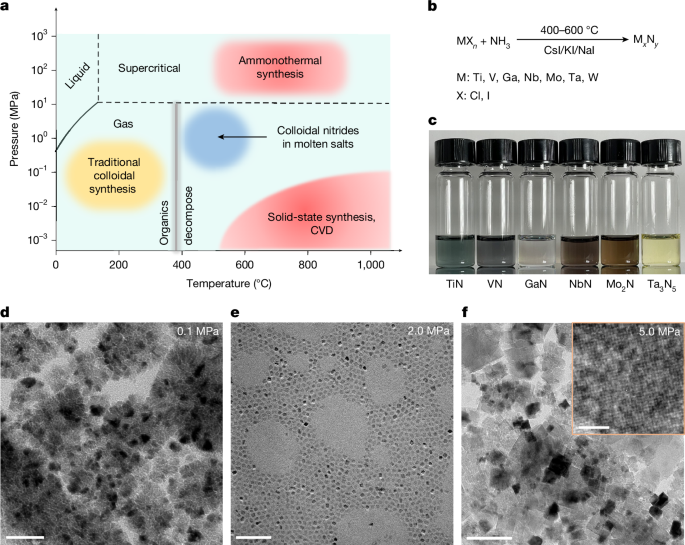
Research highlighted by Nature points to a new way to make colloidal metal nitride nanocrystals using molten salts under high pressure. The work centers on ammonia pressure as a key control in the synthesis process, helping guide the formation of these difficult-to-produce materials in a solution-based setting.
The approach is notable because refractory metal nitrides are considered technologically important, yet they can be challenging to access through conventional nanocrystal synthesis routes. By combining molten salts with high-pressure conditions, the method appears to open a broader pathway to producing a diverse set of nitride materials in nanoscale form.
A major takeaway is that ammonia pressure is not just part of the reaction environment but an important lever for controlling colloidal metal nitride synthesis. That kind of control could make it easier for researchers to tune how these nanocrystals are formed and expand the range of compounds that can be prepared.
Overall, the study suggests a practical advance in solution-based nitride production. If the method proves widely adaptable, it could improve access to refractory metal nitride nanocrystals for use in advanced materials research and other high-performance technologies.