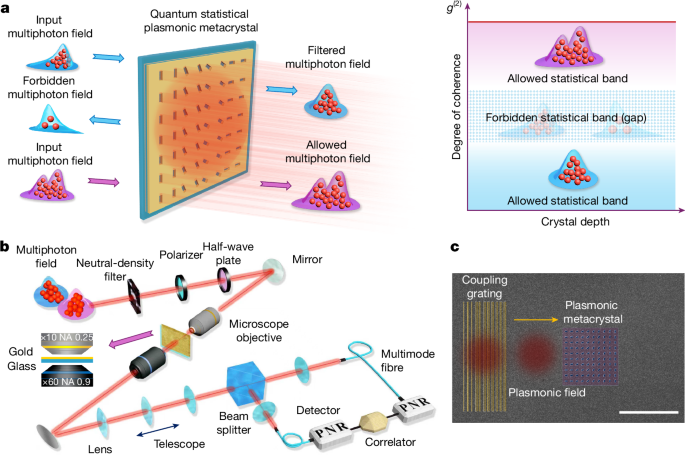
Researchers have described a new class of materials called quantum statistical plasmonic metacrystals, pointing to a fresh way of controlling light at the quantum level. The work suggests these structures can distinguish between different kinds of light not by color alone, but by their quantum coherence and statistical behavior.
The idea echoes how semiconductors rely on band structures that determine which electronic states are allowed or blocked. In this case, the reported materials appear to create similar allowed and forbidden regions for photon statistics, opening a path to engineer how light passes through a structure based on its quantum properties.
That makes the finding notable for plasmonics and photonics, where researchers are looking for finer control over how light is generated, guided and filtered. If photon statistics can be selected in a predictable way, these metacrystals could expand the toolkit for designing devices that work with quantum states of light rather than only classical optical signals.
The study adds to broader efforts to build materials whose behavior is shaped as much by quantum effects as by conventional structure. By linking plasmonic design with selective transmission of light based on coherence, the research outlines a potentially important direction for future quantum optical technologies.