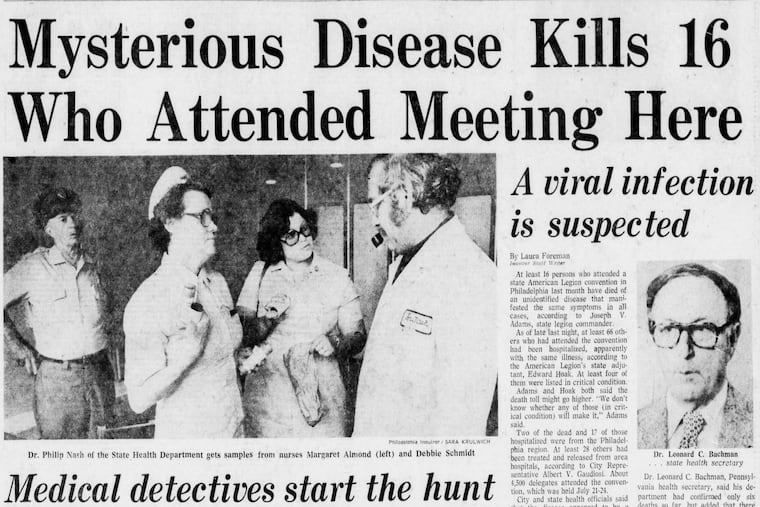
Fifty years after the Philadelphia outbreak that gave Legionnaires’ disease its name, the case still stands as one of the most unsettling public health mysteries in the city’s history. The illness was linked to American Legion members who had gathered for a convention at the Bellevue-Stratford Hotel, where a deadly cluster of cases emerged.
At the time, Philadelphia was already dealing with disappointment around its Bicentennial celebrations when thousands of American Legion members arrived in late July. What followed deepened the sense of unease: local and federal health authorities spent more than half a year trying to understand what had killed convention attendees.
The long investigation turned the outbreak into a national story because the cause was not immediately clear. The unexplained deaths, the prominent convention setting, and the slow pace of answers kept attention fixed on Philadelphia as officials searched for the source of the illness.
That episode ultimately gave the disease its name, tying Legionnaires’ disease to the American Legion gathering where the mystery began. Half a century later, the Philadelphia outbreak remains a defining example of how difficult it can be to trace a new or poorly understood public health threat.