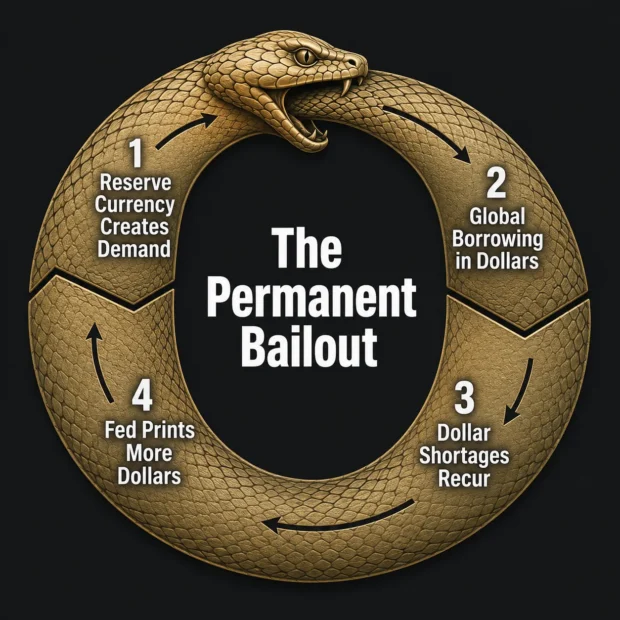
"The Permanent Bailout" revisits a familiar financial warning through Ernest Hemingway’s line about collapse happening "gradually, then suddenly." The article uses that idea to frame a broader argument about debt, market support and the risks of treating emergency rescues as a normal part of the system.
At the center of the piece is August 2011, when Deven Sharma, then president of Standard & Poor’s, led the first-ever downgrade of the United States. That move is presented as a historic turning point, especially because S&P is one of the three dominant credit ratings agencies and the US had long been viewed as the benchmark for top-tier creditworthiness.
From the available excerpt, the article appears to connect that downgrade to a larger concern: that repeated interventions and bailouts can become permanent rather than temporary. In that view, financial stress does not disappear; it is delayed, reshaped or transferred, while underlying pressures continue to build.
The piece ultimately frames the 2011 downgrade as more than a one-time ratings decision. It is used as a symbol of deeper unease about debt sustainability, confidence in institutions and the long-term consequences of relying on continuous support to hold the system together.