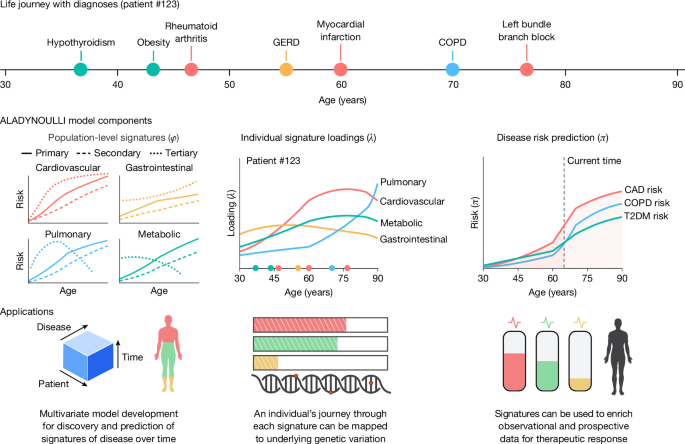
Researchers have presented a Bayesian generative framework designed to connect two major sources of medical information: longitudinal electronic health records and genetic data. The goal is to detect hidden, or latent, disease signatures that may not be obvious when each dataset is studied on its own.
According to the Nature report, the approach is built to work with patient records collected over time, rather than relying on a single clinical snapshot. By combining that timeline of health information with genetic signals, the model aims to capture patterns linked to how diseases emerge, cluster or progress.
The trimmed article snippet indicates the study lays out the mathematical structure of the model, along with its assumptions and implementation details. It also names the system as the ALADYNOULLI model, suggesting the work is centered not only on a biological question but also on a formal statistical method for integrating complex medical datasets.
The broader significance of the framework is its potential to improve disease discovery from real-world health data. If successful, methods like this could help researchers better characterize patient subgroups and reveal connections between clinical histories and inherited risk.