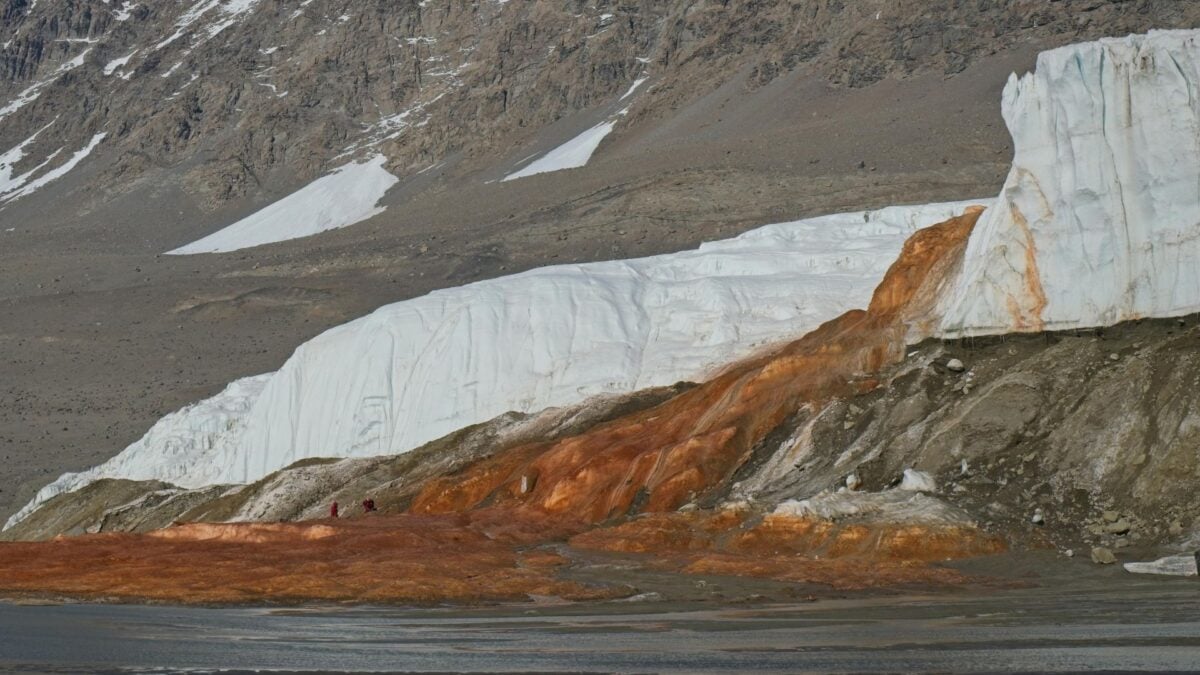
Scientists studying Antarctica’s Blood Falls say a hidden community of ancient microorganisms may finally help explain one of the continent’s strangest natural features. The crimson outflow appears at the edge of Taylor Glacier in the McMurdo Dry Valleys, where red-tinted water spills toward Lake Bonney below.
Blood Falls has long stood out because of its dramatic color and isolated setting. Researchers now believe the microscopic life linked to this unusual water could hold important clues about where the flow comes from and why it behaves the way it does. That makes the discovery significant not only for understanding the glacier itself, but also for solving a scientific mystery that has persisted for years.
According to the report, the microbial community is seen as central to tracing the origins of the feature. By examining how these organisms survive in such an extreme Antarctic environment, scientists may be able to reconstruct the conditions beneath or within the glacier that feed the red outflow.
The finding adds a new biological angle to a site often discussed for its striking appearance. Instead of focusing only on the red water pouring from Taylor Glacier, researchers are now looking at the ancient life tied to it as the key to understanding how Blood Falls formed and why it continues to emerge in one of Earth’s harshest landscapes.