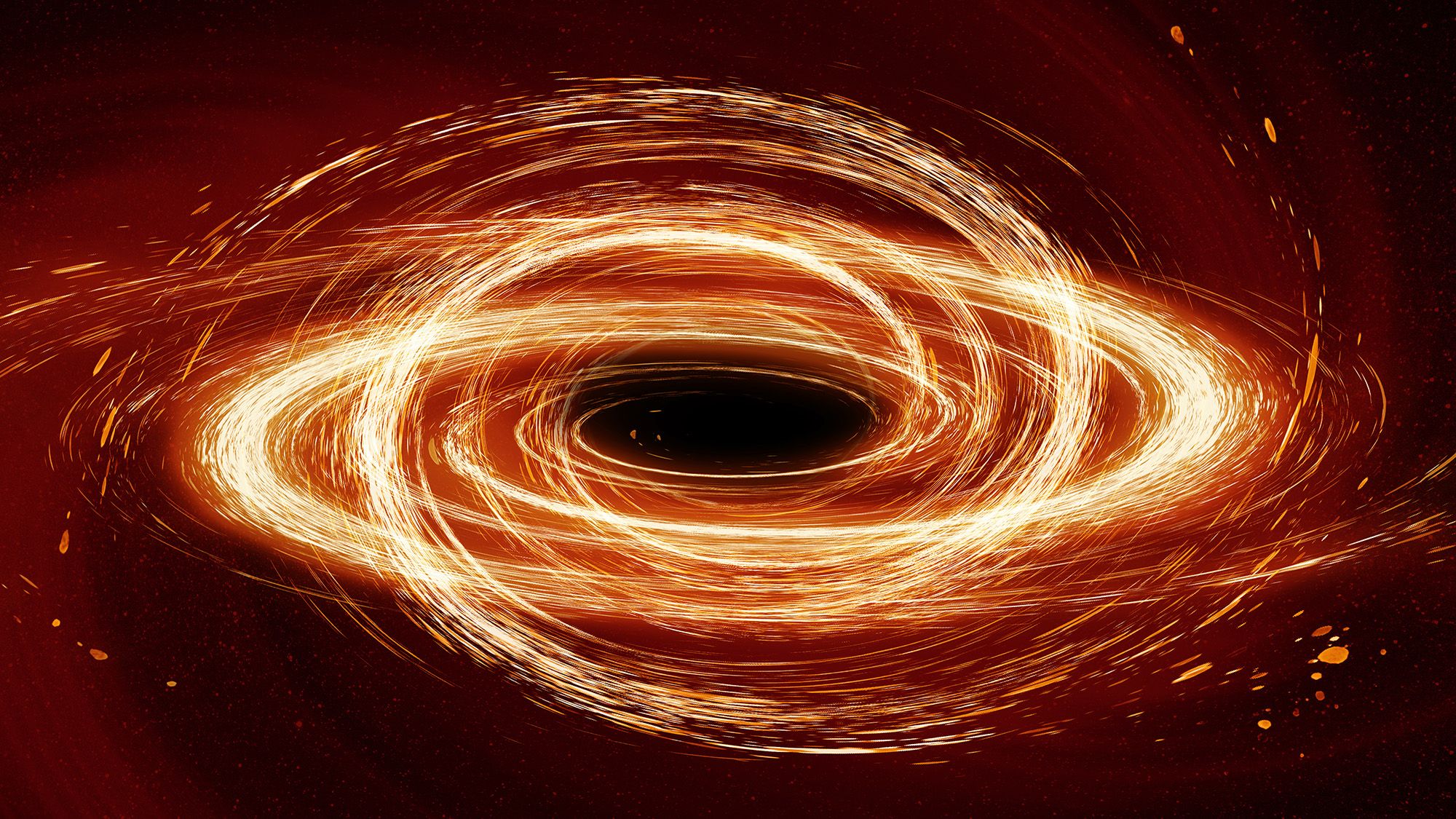
Physicists have reported a breakthrough in the study of Hawking radiation by creating a miniature black hole analogue out of light in a laboratory setting. The work gives researchers a new way to investigate one of Stephen Hawking’s most famous predictions without relying on observations of distant black holes in space.
Hawking radiation describes the idea that black holes are not completely dark, but can emit a faint form of radiation because of quantum effects near their boundaries. Testing that prediction directly has been extremely difficult, which is why scientists have long searched for laboratory systems that can reproduce similar physics in a controlled environment.
In this case, researchers used light to build a tiny black hole-like system and study how Hawking-style behavior may appear at extremely small scales. The experiment is described as a major step forward because it lets physicists probe aspects of black hole physics that are otherwise nearly impossible to observe directly.
Although the setup is not the same as a real astrophysical black hole, it offers a practical model for exploring the link between quantum theory and gravity. The result adds momentum to efforts to understand Hawking’s elusive radiation theory and shows how light-based experiments can bring abstract ideas in modern physics closer to direct testing.