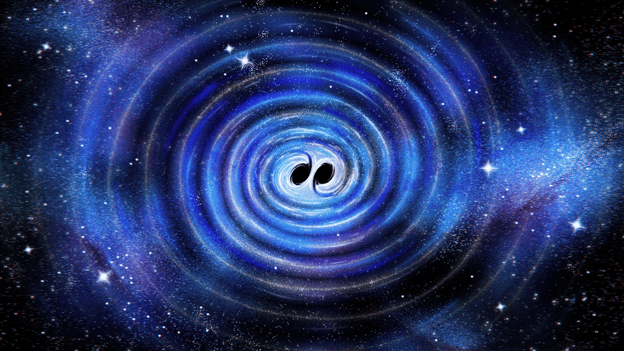
Physicists are reporting an unexpected link between black hole mergers and thermodynamics, suggesting that the aftermath of some collisions may be easier to describe than expected. According to the study, the remnant left behind by a merger of two non-spinning black holes could be predicted with a simple entropy-maximization principle.
The idea centers on thermodynamics, the branch of physics that connects energy, heat and entropy. In this case, the researchers argue that a basic rule about maximizing entropy may be enough to anticipate the final state of the merged black hole, rather than treating the outcome as something that can only be understood through more complicated approaches.
The work is presented as a conjecture, not a final proof, but it points to a striking possibility: that black hole merger remnants follow a simple organizing principle. If that holds up, it would strengthen the long-discussed relationship between black holes and thermodynamics and offer a new way to think about how these extreme objects settle after colliding.
The study focuses specifically on non-spinning binary black hole mergers, so its implications are framed around that case. Even so, the result stands out because it ties one of the most violent events in the universe to a compact thermodynamic principle that may predict the properties of the object left behind.